Yearly Archives - 2016

Art Supplies Storage Tips

Art Supplies Storage Tips

It’s a well-known fact that a temporary change in location may spark new ideas or help refine those already generated. This is especially true when it comes to artists who create some of their most stunning fine art pieces while traveling around the world. Thus, if you are one of such artists, most likely you have art supplies and even partially completed projects stored in different places you work in. So let us give you some useful advice on how to store your art supplies and what exactly you can safely store for several seasons without damage.

Unfinished canvas art pieces

Partially completed paintings should be stored vertically on a special canvas art storage rack away from any risk of moisture damage. For this reason, the best you can do is to use a reliable museum-quality storage facility like the one offered by Fine Art Shippers. Secure, clean, and climate-controlled art storage is always a wise idea if you want to get your unfinished works of fine art safe and sound.

Paintbrushes

You can store your paintbrushes for many years as long as you keep them in good condition. All you should do is to carefully wash and dry them right after each use. Moreover, even if you usually use a paint thinner or water, a long-term art supplies storage requires a special brush cleaner. Besides, make sure you store your paintbrushes away from any leaky paint tubes.

Charcoal and chalk

Charcoal and chalk can be damaged by sudden and frequent changes in humidity levels. However, these art supplies can be stored for many years in case they are kept in airtight and waterproof plastic containers with lids.

Pencils

Pencils and colored pencils, especially those with soft wax content, can be easily damaged by moisture and heat. The fact is that these essential art supplies may lose their pigment potency or even melt if subjected to constant moisture and temperature changes. In this way, forget about storing them in an un-air-conditioned room or unheated garage. Climate-controlled art storage is the best option for high-quality pencils and other professional art supplies. 

Watercolor paints

You can store watercolor paints for a few months. As long as the paint tube is not dried out, it is good for the next season. So make sure you have wiped the excess paint off the dispenser and caps before leaving them for storage. Moreover, all of the paint tubes should be necessarily sealed tight.

Acrylic paints

Acrylic paints can be stored for 5+ years (some of them can last even over 10 years). To prepare them for art supplies storage, first of all, make sure that the tubes don’t have leaks. In case, there is a leak, use duct tape in order not to let air ruin the paint. Once you are sure there are no pinholes and leaks, wipe away any excess paint from each tube. For storage, you can use airtight, waterproof plastic containers.

Oil paints

Professional oil paints can last for 10 – 20 years or sometimes even longer, so you can easily store them at home. However, don’t forget about airtight plastic containers and temperature and humidity control, as heat and moisture may cause these art supplies to age faster. Use a cloth to wipe off the residue paint around each cap and screw them tightly before storing. Besides, it is recommended that you store oil paints cap end down.

In this way, if you want to extend the life of your art supplies and unfinished paintings, just follow the above tips or entrust this work to a professional art moving and storage company like Fine Art Shippers!
Fine Art Shippers

Childe Hassam’s Painting Gifted to the New York Historical Society

A monumental piece of canvas art by Childe Hassam depicting dozens of American flags has been donated to the New York Historical Society by Richard Gilder. It is one of the last paintings from the world-known “Flag” series to have remained in private hands.

Childe Hassam, a pioneer of American Impressionism noted for his urban and coastal scenes, was born in 1859. This talented artist began his career as a free-lance illustrator in Boston, but in 1886 moved to Paris to study at the prestigious Academie Julian. Three years later, he returned to the United States and settled in New York City. Childe Hassam quickly gained critical acclaim as his paintings grew in popularity.  Thus, by 1909 he was already enjoying great public success, earning $6,000 per work. Moreover, six of his awesome paintings were introduced at the legendary 1913 Armory Show that is widely credited for bringing modern art to New York. In general, during his lifetime, the artist created more than two thousand pastel, oil, and watercolor paintings, as well as a large number of prints. Childe Hassam died in East Hampton in 1935, at age 75.

The donated to the New York Historical Society canvas is the second work from the “Flag” series that consists of 30 paintings created during the period of 1916 to 1918. Originally named as “The Fourth of July, 1916,” it depicts Fifth Avenue decorated with Stars and Stripes during the Independence Day celebration in New York held in 1916 when people united by patriotism and love of country took to the streets to support the “Preparedness Movement” in anticipation of the imminent U.S. entry into World War I in Europe. This Hassam’s masterpiece of canvas art that is more than 3 x 2 feet in size very accurately conveys the people’s mood of that memorable day.

Although Childe Hassam is not the only artist who created flag-themed works (let’s just remember Claude Monet and Jasper Johns), his paintings depicting flags on New York’s most fashionable streets have a distinctly American character complemented with the artist's artistic vision and his own compositional style. The “Flag” series includes both, oil painting with the flags dominating in the foreground, as well as paintings with the flags that are just a part of the festive panorama. It’s interesting that Hassam’s famous “The Fourth of July, 1916” work first introduced at the New York’s Montross Gallery was also a part of Frank Sinatra’s art collection. However, today it is available to the public of the New York Historical Society. The Museum is going to host a traveling exhibition of fine art in the spring of 2017. It will coincide with the 100th anniversary of the U.S. entry into World War I. Moreover, you can also enjoy the Childe Hassam’s Flag paintings in the art collections of the National Gallery of Art (Washington, D.C.), the Princeton University Art Museum (Princeton, New Jersey), the Virginia Museum of Fine Arts (Richmond, Virginia), and the Metropolitan Museum of Art (New York City).

How to Display Modern Wall Art?

How to Display Modern Wall Art?

Any collection of modern wall art deserves to be displayed. So let us give you some advice on how to arrange your artworks at home!

Symmetry is crucial

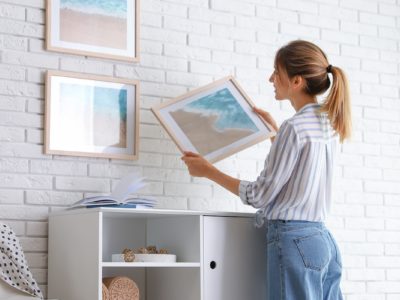
Proper art hanging is crucial if you want to create a peaceful, soothing atmosphere at home. The secret lies in symmetry. You can achieve it by choosing paintings that are identical in size, have a common color scheme or the same frames. Arrange your art collection along hallways or above large pieces of furniture, such as tables and sofas. Focal walls also work well.

Rotating art collection

In case you have more fine art pieces than space to display them in a proper way, the best thing you can do is install special picture rails and set up a simple rotating system. Try to place picture rails just below eye level to provide your fine art pieces with an excellent height for viewing. If you want to create a more dynamic display, place smaller objects in front of the larger ones, and don’t forget to change out your artworks regularly to keep your home exhibition eye-catching and fresh.

Eclectic art collection

If your collection of modern art consists of objects with different subject matter, varied styles and sizes, or unique frames, you do not necessarily need to separate them. The collection will actually benefit most if you display it grouped together rather than each object separately. So how to arrange such a collection? First of all, place the largest paintings and only then use the smaller ones to fill in the gaps. Try to keep the space between art pieces uniform and quite small to create a feeling of cohesion instead of scattering the art. Keep in mind that using real fine art pieces when trying to find the configuration you like is a bad idea. Cut out the templates from the kraft paper and move them around the wall to find out the most visually pleasing and balanced grouping. Don’t forget about symmetry!

In fact, there are no strict rules on how to display and hang the art collection. Everything depends on the collection itself and available space. So search for ideas online or order professional interior design, art consultation, or picture hanging service! If you need any help, please do not hesitate to contact Fine Art Shippers!

Fine Art News

Fine Art News

Sotheby’s auction house is going to sell the most valuable historical object from China ever put up for sale. French street artist JR will make the Louvre’s Pyramid disappear. Five unique paintings by Francis Bacon were stolen in Madrid. Large inflatable white rabbits will appear all over the United States. It’s the latest fine art news on everyone’s lips today!

Who will get the Mandate of Heaven seal?

This spring on April 6, Sotheby's Hong Kong will sell the most important and valuable Chinese historical object ever offered at the auction sale. The Mandate of Heaven seal, the most powerful and largest seal carved for Kangxi, China’s longest-reigning emperor, will be auctioned at the upcoming “Kangxi — Emperorship and Power” sale. What is more, it will be complemented by several other important fine art objects and historical artifacts, including the Baosou, a complete record of the Kangxi’s seals dated circa 1781, and the Yuanjian Zhai soapstone seal. Bidding will start with $6 million. The fine art exhibition will be opened to the public on April 1-5 at Sotheby’s Hong Kong.

Louvre’s Pyramid will disappear

French street artist JR intends to transform one of the Louvre’s symbols with a surprising anamorphic outdoor art installation this summer. He plans to install his artwork in the museum’s main courtyard, the Cour Napoleon. The artist has noticed that from a certain point of view, the bottom of the famous Louvre’s Pyramid will fade into the facade of the museum. The perspective is the central art installation theme frequently used by JR. Moreover, all of his outdoor art masterpieces are inextricably linked to their location. Thus, the large-scale project in the favelas of Rio de Janeiro was seen only from a certain position while the art installation displayed in New York City and South Africa was viewable only from above. Lets’ just remember the haunting “Unframed – Ellis Island” outdoor art exhibition at an Ellis Island abandoned hospital in New York that made headlines in 2014!

Strange theft of Bacon’s paintings

Francis Bacon’s five paintings estimated at €30 million were allegedly stolen in Madrid. According to El Pais, thieves snuck into the art collector’s house while the owner was away, disabled the alarm system, and took the paintings without any trace of their handiwork. It is still unknown what exactly Francis Bacon’s paintings were stolen, but modern art specialists state that it would be extremely difficult to sell any of them. It is noteworthy that the theft itself occurred last June and, therefore, it is unclear why news about it has appeared only now.

Watch out, rabbits!

Australian artist Amanda Parer is going to bring her famous outdoor art installation to the United States.  A series of five large white rabbits will be exhibited in San Francisco, New York, Houston, Los Angeles, Denver, and Memphis. Illuminated in stark white light, these inflatable large art pieces made from nylon stand tall yet relaxed at an impressive 7m high. Amanda Parer’s fantastic “Intrude” outdoor art installation was already displayed in Sydney, London, Perth, Paris, and other cities around the world. So don’t miss the chance to see these spectacular large “sculptures” with your own eyes!

Canvas Art Storage Tips

Canvas Art Storage Tips

No one wants his or her canvas art investment to be ruined during the moving or storing process. Thereby, no matter whether you have framed or unframed canvas art pieces, it is highly important to keep your possessions safe. For instance, the process of properly storing canvas art should include special art storage environments, materials, and certainly the right art handling methods. Only in such a case, you won’t have to worry about scratches damaging your precious art collection, not to mention mildew and mold. So here are some valuable tips that will help you protect canvases for storage:

Handle only one canvas art piece at a time. The fact is that if you carry several paintings from one place to another at once, the frames and canvases may scratch each other. Therefore, handle only one canvas art piece at a time, even if it takes a little longer than you would like it to be.

Always use light cotton gloves and acid-free paper. Acid-free paper is required for exposed paintings. It is used as a layer between the canvas and a cotton dust cover. As for the cotton gloves, you should wear them every time you handle any of your canvas art pieces as oils from your fingers may smudge the paintings and damage the glass as well.

Eliminate the sunlight. Keep your canvas art collection in a dark room without windows. If it is not possible, board up the windows and make sure that the sunlight won’t enter. The fact is that sunlight is among the greatest enemies of canvases. It damages the paint and breaks down the canvas fibers. So if you do not want your art collection to be ruined, eliminate the sunlight.

Store canvas art pieces upright. The best option is to use special canvas racks that hold paintings separately in upright slots. This is crucial for long-term art storage. However, if it comes to temporary storage, then you may store paintings stacked between padding or flat on their backs. Please note that it works only for a short period of time as canvases tend to sag.

Store you art collection in a climate controlled facility. Store your canvas prints and paintings in a humidity- and climate-controlled unit where temperature and moisture are kept at a constant level. This is of paramount importance as too cold, too hot, too damp, or too dry air may deteriorate your canvas art collection.

At Fine Art Shippers, we offer affordable art storage services in a climate-controlled and, what is also very important, secure warehouse completely covered with our umbrella insurance. Being a professional shipping company, we also use a fully automated fire sprinkler system that guarantees full protection for any of your fine art pieces. Please contact us for any further information.

Foam Core Boxes for Art Packing? Why Not?

Foam Core Boxes for Art Packing? Why Not?

You may be surprised, but custom-made white foam core boxes are truly a good decision for art packing when it comes to sensitive and valuable items like jewelry, gems, antique firearms, masks, musical instruments, some sculptures, fossils, china, textiles, and other fine art objects. Moreover, depending upon the type of contents and certain conditions, such boxes can be easily used for art handling and shipping by themselves. In other cases, foam core boxes are additionally packed into another custom-made box, bin, or museum crate for transportation. Besides, they can be simply used to keep small fine art objects within the bigger box secure and, what is also important, correctly oriented.

Here are just some of the main advantages of white foam core boxes:

- they are more rigid than cardboard boxes while their exterior is more attractive and clean; - the cost of a foam core box is very attractive compared to wooden custom crates; - they are easy to see and inventory and, therefore, they will never be overlooked when unpacking; - they can be used for clear separation and enhanced protection of multiple fine art objects within larger boxes; - you can label them with safety instructions, as well as affix some photos to the exterior to confirm specific content; - their interior can be fitted with a range of options starting from simple foam for stable fine art objects to cavity packs; - they are easy to handle, open, and re-pack; - they fully protect fine art pieces from debris and dust; - there is a great variety of available constructions, including side opening and top opening boxes; - foam core material can be cut to almost any size to fit the particular fine art object.

In addition to all this, white foam core boxes allow for the inclusion of not only careful labeling but also detailed unpacking instructions that can be written right on them with a marker. Why are they so important for fine art shipping and packing? Experienced art shipping companies know that so-called “damage in transit,” in fact, occurs not during actual freighting or transportation of fine art objects. The truth is that it often occurs during packing, re-packing, and unpacking processes. So the more detailed instructions you have, the better. That is why white foam core boxes fit like no other for careful art transportation. The placement of hinges, affixed handles, folded tape, labeling – all this serves for the box to be opened only one way, thus providing its content with greater protection. Thereby, when it comes to shipping valuable or delicate fine art objects, custom-made foam core boxes with clear labeling and unpacking instructions are a good option for both, professional art shipping companies and customers, who certainly appreciate “white glove” moving services with attention to every little detail.

Fine Art Shippers

New York’s Metropolitan Museum of Art Has Set Its Own Record

Last year, the main New York City tourist attraction, the Metropolitan Museum of Art, generated $946 million in tourist spending in New York. Such a number comes from a visitor survey conducted by the Museum’s market research office. As it turned out, approximately 54% of the interviewed people reported that visiting the Metropolitan Museum’s exhibitions of fine art played a crucial role in their decision to visit New York City. We are talking about three summer exhibitions that were a great success last year: “Sargent: Portraits of Artists and Friends,” “The Roof Garden Commission: Pierre Huyghe,” and certainly “China: Through the Looking Glass.” So let’s go through it all point by point!

According to the recently released survey, the New York’s Metropolitan Museum of Art welcomed 6.3 million visitors during the period from July 2014 to June 2015. It has become the largest number since the Museum began tracking this statistic over forty years ago. So this is truly a new record for an already blockbuster museum! It is also noteworthy that 26% of fine art lovers were New York residents, and the other 74% of visitors came from outside the Big Apple. Moreover, 2.5 million visitors were attracted by the already mentioned summer exhibitions of fine art. As for the massive number of $946 million – this is the total sum brought to New York City’s Budget by tourists who were attracted by the following Metropolitan Museum’s exhibitions.

“Sargent: Portraits of Artists and Friends” is a captivating exposition of experimental oil paintings and drawings by John Singer Sargent. This celebrated American artist created portraits of famous people, many of whom were his close friends, in informal poses, for instance, in the act of performing, singing, or painting. These masterpieces of canvas art depicting Auguste Rodin, Claude Monet, Henry James, Robert Louis Stevenson, Judith Gautier, and other leading figures in the creative arts of the time are highly charged while being very intimate and sensual. So it’s not surprising that this unique New York exhibition of outstanding paintings attracted 254,750 visitors from different countries.

“The Roof Garden Commission: Pierre Huyghe” outdoor art exhibition held in New York during the period from May to November was visited by 483,208 connoisseurs of modern art. This rooftop art installation created by the French artist Pierre Huyghe is a kind of an investigation, the way the author thinks about the links between science, history, and the environment. However, such a large amount of visitors is explained not only by people’s craving for contemporary art but also by stunning background and decorations.

“China: Through the Looking Glass” is the most popular among New York’s exhibitions for the last summer. It attracted 815,992 visitors. It's nothing surprising about that because vintage and new Haute Couture dresses placed next to Chinese antique masterpieces to show the impact of Chinese culture on the Western world and contemporary art are a real miracle.

Fine Art Shipping Insurance and Rejection of It

Fine Art Shipping Insurance and Rejection of It

Some customers believe that booking a shipment or ordering other services related to fine art always means that the whole process of artwork transportation and the art objects themselves are automatically insured by art shipping companies. It’s a big mistake, as well as the assumption that service providers, by default, have full liability in case of damage or loss. The reality is that art handlers and fine art movers would not be able to function in such a case, as dealing with potentially millions dollar property from day to day would become an overwhelming task. For this reason, art shipping companies always have limited liability for uninsured artworks, which is, frankly speaking, almost useless in the realm of art coverage. In other words, if you don’t declare the value of your property and pay a premium for insurance, do not count on the full coverage, no matter the reasons for damage or loss. This is exactly the reason why we consider it mandatory for our customers to use the insurance for their property during art handling and transportation. However, if for some reasons, you are not asked about the insurance, pay attention to the documents provided by the art shipping company. If there is no value declared or no other notice of insurance, then your property is most likely not insured.

In spite of this clarity, some people still remain confused when it comes to fine art shipping insurance, especially after some damage or loss has occurred. In this way, do not be surprised if you are asked to sign a special opt-out or rejection form in case you decline the insurance offered by the service provider or its partnering companies. Moreover, the same may apply to the case when you have your own all risk insurance. Why is it so? Experience shows that some customers who claimed they were insured, in fact, were not or, at least, needed to update their coverage and appraised values. So if you are going to decline the insurance because you think you already have one, please send the art shipping company proof of that coverage before signing the opt-out form. If there are any problems with your own policy documents, you will have a chance to solve them until it is too late.

At Fine Art Shippers, we offer professional insurance assistance and all the required consulting services to simplify the insurance procedure as much as possible. We can also help you choose the best insurance package that will suit your particular situation, expectations, and needs so that you could save your money on extra services. Our partnering insurance companies provide specialist fine art cover for museums and galleries, individual art collectors, as well as a range of businesses in the world of art. This simply means that you are in safe hands when it comes to insurance as part of the artwork transportation and handling processes. Contact Fine Art Shippers now for more information!

Fine Art Shippers

TEFAF Maastricht to Launch Art Fairs in New York

TEFAF Maastricht, the most prestigious European fair dedicated to fine art, antiques, and design expands to New York! Thus, the world’s foremost fair of art and design will allow art collectors and dealers to meet one more time at the Park Avenue Armory. As reported by “The New York Times,” TEFAF New York Fall Fair devoted to art from antiquity to the XX century will be held on October 22 – 27, 2016. The following Spring Fair focused on contemporary and modern art and design will premier in May 2017. Each fair will include approximately 80 to 90 fine art dealers from all over the world.

It is worth noting that TEFAF New York is a bold step against the background of declining demand for fine art and antique pieces, not to mention a large number of upscale art fairs planned for the year ahead. For instance, the first TEFAF New York Fair will take place just two weeks after London Frieze Masters and will coincide with FIAC Art Fair Paris. As for the Spring Fair, it is planned simultaneously with the iconic auctions of contemporary art held by Christie's, Sotheby's, and Phillips, as well as with Frieze New York Art Fair. However, it is truly a great chance for all art collectors not only to see world-known masterpieces but also to buy one of them for the private residence!

TEFAF Maastricht that takes place each March in the Netherlands offers antiques, Old Master paintings, furniture, modern art, and museum jewelry. It is exactly the place to find the rarest and absolutely unique art pieces like a handkerchief entirely woven from gold sold several years ago. Thereby, it’s not surprising that TEFAF annually attracts representatives of hundreds of museums and thousands of visitors. This year, the famous fair will be held on March 11 – 20. So what masterpieces to expect in Maastricht and New York in 2016? Let’s see!

Robert Aronson from Aronson Antiquairs of Amsterdam will bring a pair of octagonal garden urns created from rare Delft porcelain approximately in 1710. New York’s art dealer Otto Naumann Ltd. will present such paintings as “Mountainous Landscape with a Waterfall and a Castle on a Precipice” by Jacob van Ruisdael and “Ships in Moonlight” by Lieve Verschuier. The renowned jewelry and luxury watch manufacturer Van Cleef & Arpels has decided to sell its amazing “Iolanta Ballerina” clip made of rose-cut diamond, pink sapphires, pink diamonds, and rubies. Furthermore, the fine art fairs will also include unique contemporary art pieces created by famous modern artists as part of the “Show Your Wound” section named after Joseph Beuys’s sculptural work. All of them will be available for sale, and Fine Art Shippers will be ready to help you with local or international transportation, fine art packing, and art storage as well no matter the size or material of your art object!