

If you’re wondering why cardboard is unsafe for valuable artwork, the main concern is that ordinary cardboard is not designed for long-term contact with art or for the demanding conditions of professional art shipping. Standard corrugated cardboard can contain lignin and acidic components that deteriorate over time. These degradation products can migrate into materials they touch, contributing to yellowing, staining, and embrittlement, particularly in paper-based artwork.
Cardboard also offers limited protection against moisture, impact, pests, and structural stress. For valuable paintings, photographs, works on paper, and other sensitive objects, professional art handlers generally use archival materials and purpose-built packing systems instead.
Why Cardboard Is Unsafe for Valuable Artwork: 4 Failure Modes
A clearer illustration of why cardboard is unsafe for valuable artwork is the range of ways it can fail during storage and transportation.
- Chemical deterioration
Ordinary cardboard may contain lignin and acidic components that degrade over time. When artwork is placed directly against such materials, acids and other degradation products can contribute to discoloration and deterioration. This is particularly concerning for paper, textiles, and other sensitive materials. - Moisture absorption
Cardboard is hygroscopic, meaning it readily absorbs moisture from the surrounding air. Changes in humidity can cause it to soften, warp, or lose structural strength. In poorly controlled environments, this can increase the risk of damage to the artwork inside. - Limited impact protection
Standard cardboard boxes provide only basic cushioning. They can collapse under concentrated loads, become crushed at the corners, or transmit impact forces directly to fragile artwork. This makes ordinary cardboard unsuitable as the primary protection for many high-value or delicate pieces during long-distance transportation. - Pest vulnerability
Cardboard can provide both shelter and a potential food source for common pests, including silverfish, booklice, and cockroaches. In storage environments, damaged or poorly maintained cardboard packaging can therefore create an additional conservation risk.
Safer Alternatives for Professional Shipping
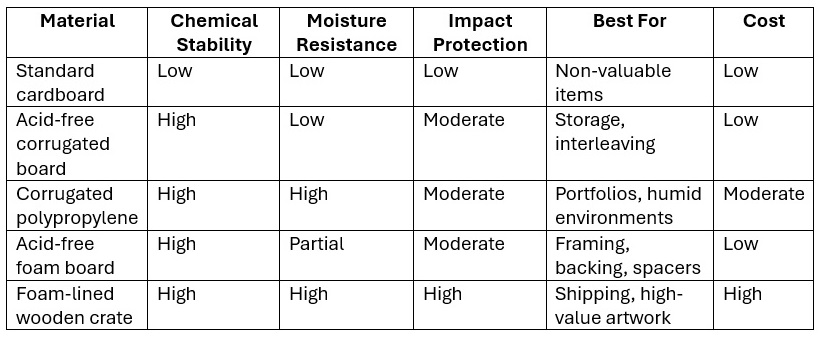
Now that you understand why cardboard is unsafe for valuable artwork, the next step is choosing materials appropriate for the artwork, environment, and transportation conditions. Common professional options include:
- Acid-free corrugated board is lignin-free and designed for archival applications. It can be used for boxes, dividers, interleaving, and other situations where a lightweight alternative to ordinary cardboard is needed.
- Corrugated polypropylene (Coroplast) is an inert, fluted plastic board that is moisture-resistant, washable, and reusable. It is useful for portfolios, temporary protection, and art handling in humid environments.
- Acid-free foam board is rigid and lightweight, making it suitable for backing and spacer applications, particularly for framed works on paper and photographs.
- Custom wooden crates with appropriate cushioning provide substantially greater structural protection than cardboard. When combined with foam cushioning and, where appropriate, a vapor barrier or other moisture-control measures, a custom crate is often the preferred solution for high-value artwork and long-distance transportation.
FAQs about Cardboard and Artwork
Can I use cardboard for short-term artwork storage?
It depends on the type of cardboard and the artwork. Short-term use may be acceptable when the cardboard does not come into direct contact with the artwork and an appropriate archival barrier, such as acid-free tissue or glassine, is used. For valuable or highly sensitive pieces, archival packing materials are the safer choice even for temporary storage.
What is acid-free cardboard?
Acid-free or archival board is manufactured to meet conservation requirements for pH and chemical stability. Many archival boards are lignin-free and may contain an alkaline buffer, such as calcium carbonate, to help neutralize acids that develop over time. The exact properties vary by product, so conservation-grade specifications should be checked before use.
Should I always use buffered cardboard?
No. Alkaline-buffered materials are often appropriate for many paper-based artworks, but they are not universally suitable for every material. Some photographs, protein-based materials, textiles, and other sensitive objects may require different conservation materials. When the artwork's composition is uncertain, professional conservators or art handlers can recommend the appropriate archival board.
What is the safest packing material for valuable artwork?
There is no single safest material for every artwork. The appropriate solution depends on the object's materials, size, fragility, value, destination, and transportation conditions. For high-value artwork traveling long distances, a custom-built wooden crate with properly selected cushioning and protective layers generally provides far greater protection than a standard cardboard box.