

When you hear about art collectors, you probably have a romanticized notion of what life must be like. You think of leisure, private viewings, interesting personalities, and, of course, priceless art. Yet, like most fields, the actual lived-in experience is far from what Hollywood or the media tends to show.
If you’re not part of the top 1% as an art collector, you have to deal with a wide range of challenges. Sometimes, the struggle can become so much that collectors decide to move out and try their luck elsewhere.
In this article, let’s look at some of the factors at play, especially for states like California, which has experienced significant art-scene displacement.
Unfavorable Politics That Create Distrust
Tax policy, especially for high-net-worth (HNW) collectors, is rarely just about the current rates. Rather, it’s about long-term predictability. As the Washington Times notes, California’s proposed 2026 Billionaires Tax Act would have taxed assets including business interests, securities, cryptocurrency, vehicles, intellectual property, and, yes, artwork. While the bill was rejected, it did leave a bad taste in the mouth for collectors and those who don’t like unnecessary risks.
The fact is that taxing physical art is particularly punitive when compared to the taxing of liquid assets. A painting or a sculpture isn’t generating any cash flow when it sits on a wall. What’s more, their valuations are notoriously subjective.
A recurring wealth tax on unrealized gains would force many collectors to seek art-backed loans, which are known to be predatory. HNW collectors like to plan across decades, and if they see that a state believes that private collections are fair game for wealth extraction, the trust is gone.
This is why a growing number of art collectors make the decision to leave states like California. It’s also why many long-distance California moving companies have increasingly expanded their services to offer specialized transport for fine art.
As Neatly Moving & Storage explains, these include custom crates, climate control for temperature and humidity, and shock protection. Such precautions are necessary, especially if one is relocating to far-away states.
Natural Disasters and Safety
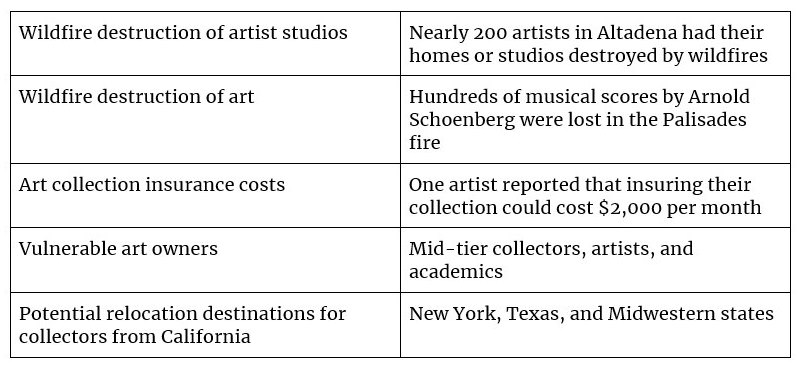
Legislative concerns are just one challenge for art collectors, though. Today, climate change has become an active threat that is already affecting the art scene. As the Guardian notes, almost 200 artists had their homes or studios burned down in wildfires in Altadena, California. Likewise, hundreds of musical scores by composer Arnold Schoenberg were lost in the Palisades fire.
Amir Nikravan, a teacher at the ArtCenter College of Design, said that the worst losses were from his personal art collection. “Most artists are collectors,” yet many of them can’t afford to insure them for $2,000 a month, he explained.
Essentially, artists, academics, and mid-tier collectors who also own museum-grade art are particularly vulnerable. It gets even worse when you consider that insurers have also pulled out of high-fire risk zip codes.
This is another big reason that causes collectors to have California moving companies pack things up and move states. Their destination? Safer places with more predictable climate like New York, Texas, and even the Midwest.
Drying Up of Opportunities
Even when tax laws and wildfires aren’t a problem, a change in culture can also play a major role in displacement. According to advisor Michael Thomas, local collectors aren’t able to support all the galleries in Los Angeles. They are expected to do miracles that can’t happen because of laid-back California culture. It’s a state that lacks the gusto of New York or London, he explains.
The fact is that art ecosystems tend to thrive best in a fiercely competitive environment. Yet, in places like Los Angeles, there is a growing disconnect between LA’s massive gallery footprint and its actual buyer base. If local collectors aren’t getting pieces at the pace that galleries need to survive, there is stagnation.
As Michael Thomas mentioned, the laid-back culture has a key role to play in this. LA artists don’t like to be rushed to produce new pieces regularly. As such, collectors are sometimes left in a state of limbo. It’s not the fault of the artist but simply a pacing mismatch between artists, collectors, and galleries. This is yet another factor that eventually drives collectors to other states as well.
Frequently Asked Questions
How should art collectors prepare their collections before moving to another state?
Collectors should start by documenting each piece, checking insurance coverage, and arranging professional condition assessments. Fragile or high-value works may need custom crating, specialized packing materials, and climate-controlled transport. It's also worth checking whether the new home has suitable storage and display conditions.
Which US states are best for art collectors to live in?
New York remains a popular choice because of its galleries, auction houses, and established art market. Texas also attracts collectors through its growing cultural scene and comparatively favorable tax environment. States such as Illinois and Massachusetts offer access to respected museums, institutions, and established collector communities.
Does homeowners insurance cover valuable art collections?
Standard homeowners insurance often provides limited coverage for valuable artwork, with per-item limits and exclusions that may leave collectors underinsured. Many owners opt for specialized fine art insurance, which can cover accidental damage, theft, and transportation. Having professional appraisals and updated inventories can also simplify claims.
Key Numbers & Facts at a Glance
It’s never an easy decision to pack up a fine art collection and move states. Collectors are well aware of the added challenges that such a decision can bring. The tax implications, logistics, and specialized transit are all tricky to figure out. Yet, many collectors find it a better alternative than staying put in states that don’t feel supportive of their work anymore.
What policymakers fail to realize is that when collectors leave, it also has a ripple effect that affects museum endowments and gallery revenue. States need to recognize how important it is to support artists and art collectors and protect them from that which drives them away.