

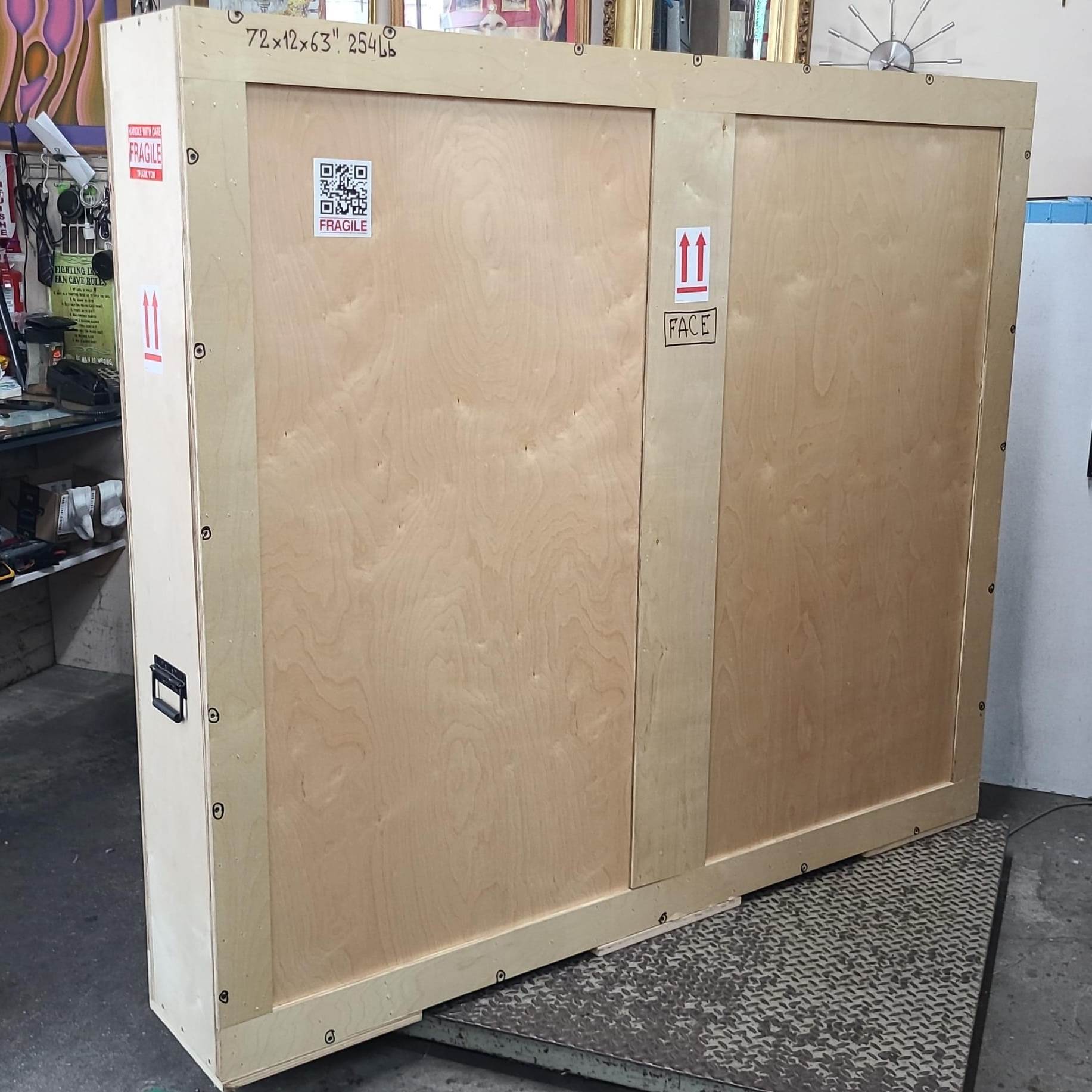
Museum shipping crates are not simply strong boxes. They are carefully engineered pieces of equipment designed for repeated opening and closing by different people in different settings without compromising the safety of the contents. This single requirement determines how a crate is built, what types exist, and when each of them is used for artwork shipping.
Anatomy of Museum Shipping Crates
A crate’s construction follows its function. Panels are made from exterior-grade plywood or other suitable treated wood products, typically 0.5–0.7 inches thick, and reinforced with a solid timber frame. Screws and washers are generally preferred as fasteners instead of nails often used in regular crate construction. An industry standard is to apply a foam gasket around the lid seam, followed by interior lining with a foil-laminate moisture barrier. The exterior is sealed and painted to make the timber more resistant to moisture.
Skids are attached to the crate’s bottom to lift it from the floor for convenient forklift access and to keep it dry, even when it spends time on wet loading bays. If the combined weight of the crate and artwork does not exceed typical manual handling limits, the crate may also be equipped with handles positioned according to the actual weight distribution rather than at the geometric center.
Typology of Museum Crates
The type of museum shipping crates used for a particular project depends on the artwork’s value, travel distance, and the expected number of handling points.
- One-way crates are built for a single trip, typically used when delivering an artwork to its new owner without plans for return transportation. They are simpler inside because repeated use and repacking are not expected.
- Reusable exhibition crates are designed for touring artworks. The internal foam cavity is cut to fit the object’s exact dimensions. Such crates require more complex engineering but are still more economical than building a new crate for every journey.
- Double crates consist of an inner crate suspended inside an outer crate on foam blocks to absorb handling impacts and help buffer temperature fluctuations. They are commonly used for high-value loans and long-haul air freight.
- Book crates open flat like a book cover. They are suitable for framed paper-based artworks or canvas paintings that require face-up handling rather than vertical lifting during unpacking.
- Slat crates have an open-frame design, making them much less expensive to manufacture. They are often used for large sculptures that do not require climate-controlled transportation.
Any of these crate types should be manufactured in compliance with the international ISPM 15 heat-treatment standard. Otherwise, carriers may refuse to transport the crate because of phytosanitary regulations.