

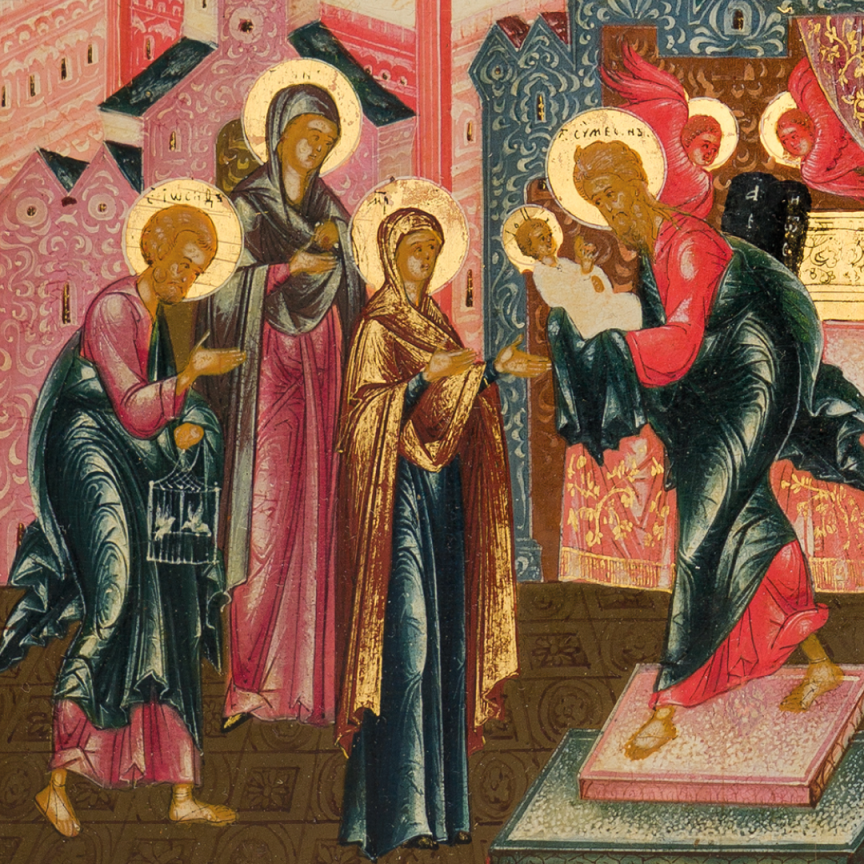
When Prince Vladimir of Kyiv adopted Orthodox Christianity in 988 AD, he embraced not only a new faith but an entire culture and visual language. By that time, Byzantine art had already reached a high level of sophistication, and its traditions—mosaics, frescoes, and panel icons—were brought to Rus’, laying the foundation for the development of Russian religious art.
The Golden Age of Icon Painting
The true flourishing of Russian religious art is often associated with the 14th and 15th centuries. During this period, masters such as Theophanes the Greek introduced a powerful, expressive style in Novgorod and Moscow, combining spiritual intensity with bold color and dynamic brushwork. His legacy was continued by Andrei Rublev, whose refined compositions and profound sense of harmony became a benchmark of Russian icon painting.
Baroque Influences and the Stroganov School of Russian Religious Art
The 16th and 17th centuries brought both richness and transformation. The Stroganov school, supported by wealthy merchant patrons, produced finely detailed, jewel-like icons distinguished by their precision and elegance. At the same time, the reforms of Peter the Great encouraged Western artistic influences, gradually introducing elements of naturalism and new compositional approaches into icon painting.
Parallel to these changes, the Old Believers preserved pre-reform traditions in remote regions, maintaining earlier iconographic canons and resisting Westernization. This coexistence of innovation and conservatism added complexity and depth to the evolution of the tradition.
The Soviet Era and Cultural Disruption
The 1917 Revolution marked a dramatic rupture. Soviet ideology sought to suppress religion, leading to the destruction of churches and icons across the country. Despite this, elements of religious art survived indirectly, influencing secular movements such as the Russian avant-garde. Artists adapted key visual principles—frontal composition, symbolic use of light, and simplified spatial structures—into new, non-religious contexts.
Contemporary Revival
The collapse of the Soviet Union in 1991 initiated a period of spiritual and artistic renewal. Churches were restored, icon painting traditions were revived, and interest in Russian icons grew both domestically and internationally. Today, this heritage is increasingly accessible, from restored frescoes in historic monasteries to Old Believer icons preserved in private collections, including that of Oleg Kushnirskiy, which can now be explored in detail through a dedicated art catalog available for purchase.
Together, these stages reflect a resilient and evolving tradition—one that continues to bridge faith, history, and artistic expression across centuries.