


There is no single best courier in New York City. The right choice depends on what you're moving.
A gallery shipping artwork to Miami has different needs from a Brooklyn roastery supplying cafés. Choosing the wrong service can mean delays, damage, or missed deadlines.
This guide covers five NYC courier services in 2026, grouped by use case rather than ranked.
The five delivery options at a glance
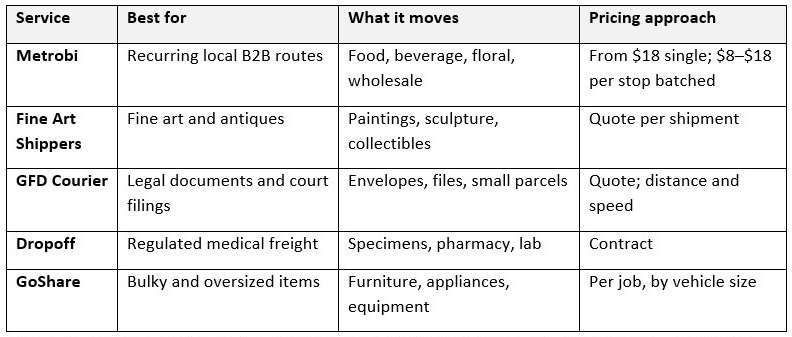
Pricing shown is indicative and current as of 2026. Confirm rates directly, as most of these services quote by distance, weight, vehicle, or contract.
Why New York Delivery Needs a Different Approach
Most courier advice assumes easy parking. In NYC, these factors matter most:
- Building access: Limited loading docks, booked freight elevators, and walk-ups can slow deliveries.
- Parking restrictions: Changing street rules and crowded loading zones complicate pickups, especially for heavy or fragile items.
- Timing over distance: Traffic, bridges, and tunnels can make short trips surprisingly slow.
- Borough coverage: Strong Manhattan service doesn't always extend to Staten Island or eastern Queens.
1. Metrobi — best for bakeries, caterers, florists, and wholesale food businesses
What it moves: Catering, food, beverage, floral, bakery, meal prep, and wholesale deliveries from a business to its own business customers.
How it works: Metrobi runs a network of vetted independent drivers alongside delivery software, operating as a courier service in New York City and across more than 25 US metros. The model suits businesses with predictable routes and unpredictable volume — a roastery supplying cafés, a florist with a Valentine's peak, a caterer whose Thursdays look nothing like their Tuesdays.
What sets it apart: Driver continuity. Businesses build a preferred-driver roster, so the same people return to the same routes and learn the buildings, the service entrances, and the accounts. For recurring B2B work that matters more than raw speed: a driver who already knows which door to use at a Midtown office tower is worth more than one who happens to be five minutes closer.
What it costs: Pricing is per delivery rather than per driver seat — from $18 for a single delivery, and $8–$18 per stop on batched routes depending on stop count and ZIP density. Businesses that already run their own drivers can use the route planning, tracking, and proof-of-delivery platform free.
Worth checking: Metrobi is built for metro-scale recurring work. It is not the right fit for long-distance shipping, document-only runs, or one-off consumer parcels.
2. Fine Art Shippers — best for fine art, antiques, and high-value objects
What it moves: Paintings, sculpture, antiques, collectibles, and anything where the handling matters as much as the transport.
Who it serves: Fine Art Shippers has been moving artwork for over three decades, serving galleries, auction houses, museums, dealers, and private collectors. The work spans packing and crating, art insurance, installation, and both domestic and international transport.
What sets it apart: The art shuttle. Consolidated routes depart New York on published schedules in specialized trucks staffed by trained art handlers, so a single piece travels alongside other artworks rather than requiring a dedicated vehicle.
What it costs: Quoted per shipment rather than published as a rate card because the variables are the object rather than the distance — dimensions, fragility, whether it needs a custom crate, declared value for insurance, and whether installation is included at the other end.
Worth checking: Shuttles run to a schedule, so this is a planning-ahead service rather than an on-demand one.
3. GFD Courier — best for legal documents and court filings
What it moves: Envelopes, case files, signed originals, and small parcels on a deadline.
How it works: GFD has been running messenger services in New York for close to three decades, serving legal, medical, and retail clients across the city and the tri-state area. Local deliveries are typically completed within two hours, with rush options for tighter windows.
Why legal is different: A filing deadline is absolute, chain of custody for originals is not optional, and the courier needs to know how a specific courthouse mailroom operates.
Worth checking: For regularly scheduled interoffice runs rather than ad-hoc rushes, ask how recurring routes are priced against per-job rates.
4. Dropoff — best for regulated medical and pharmacy deliveries
What it moves: Lab specimens, pharmaceuticals, medical records, and anything with a compliance requirement attached.
Why compliance drives the choice: Healthcare logistics is the one area where the paperwork is as important as the delivery. Dropoff operates as a HIPAA-compliant courier with chain-of-custody procedures, serving pharmacies, labs, and healthcare suppliers.
What it costs: This is contract rather than on-demand work. Pricing is quoted against volume and service level rather than published per-delivery, which suits organizations with predictable recurring runs between facilities.
Worth checking: Confirm coverage across all five boroughs and any temperature-controlled handling you need, particularly for specimens with short viability windows.
5. GoShare — best for bulky and oversized items
What it moves: Furniture, appliances, building materials, equipment, and anything a parcel network will refuse.
How it works: Parcel carriers cap out well below the weight and dimensions of a sofa or a commercial refrigerator. GoShare is booked on demand with help loading and unloading included.
Why it suits New York: You choose the vehicle to the job. A cargo van that can actually park on a side street beats a box truck that cannot, and for walk-up buildings, the labor included in the booking matters more than the drive.
Worth checking: Confirm what is covered if an item is damaged in transit, and whether the vehicle class you need is reliably available in your borough at the times you deliver.
How to choose the right delivery service?
Start with what you’re shipping and whether deliveries are recurring or one-off, since those two factors rule out most providers quickly. Then weigh what a missed delivery would actually cost you and how easy the destination is to access because buildings without loading docks make careful handling more important than speed. Narrow your list to two or three options and test each one against a real delivery scenario instead of comparing rate cards.