

Every few years, some new lighting trend gets declared the thing that will finally replace the crystal chandelier — industrial cage pendants, Sputnik fixtures, minimalist rings. And yet, crystal keeps showing up in the rooms people actually remember. There's a reason for that, and it has less to do with nostalgia than most people assume.
It's Not About Looking Expensive — It's About How Light Behaves
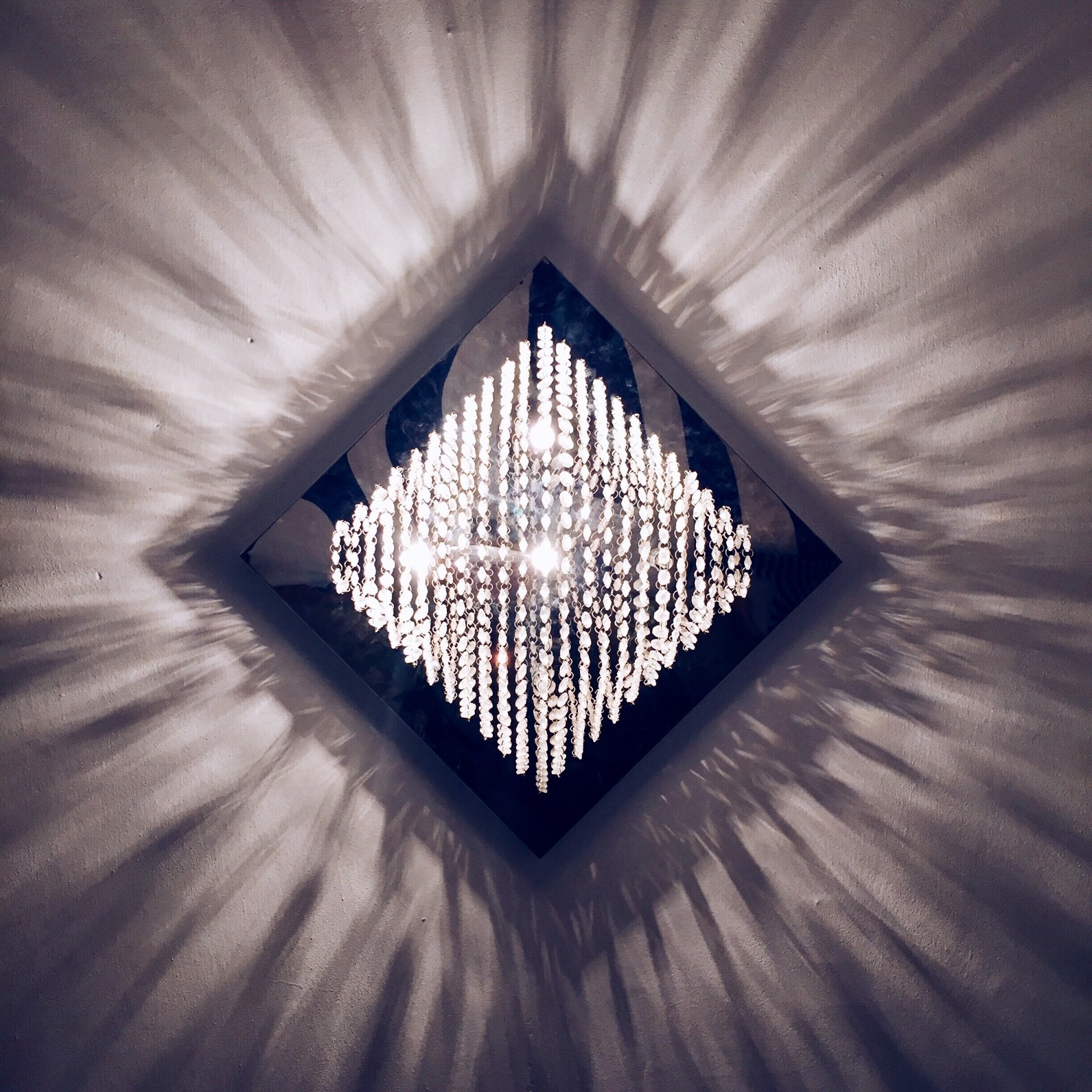
What separates a crystal chandelier from other overhead fixtures is physics, not aesthetics. Real cut crystal bends and splits light in a way flat glass can't. Each facet acts like a tiny prism, so instead of one source of light, you get dozens of small reflections moving across the ceiling, the walls, even the table beneath it.
That's the part people respond to without knowing why. A pendant light illuminates a room. A crystal chandelier animates it. Walk into a dining room with a tiered crystal piece overhead at golden hour, and you'll see it — there's a shimmer happening that a drum shade or metal ring fixture can't replicate.
Where the "Too Formal" Reputation Comes From
If you grew up around crystal chandeliers, the ones you remember were probably heavy, ornate, dripping with strands, hanging in a dining room nobody used except on holidays. That image has stuck around longer than the actual product category has.
Designers have spent the last decade stripping crystal down to its essentials — keeping the sparkle, losing the bulk. You'll now find crystal worked into clean ring silhouettes, slim linear bars, spiral forms that wind through a stairwell, and minimal frames where a handful of faceted drops do the work of dozens of tiers. The crystal hasn't changed. The frame around it has, which makes the category usable in rooms that would never have considered it ten years ago.
The Rooms Where Crystal Actually Earns Its Place
Dining rooms are probably still the strongest fit — you're sitting underneath the fixture for extended periods, often with lights dimmed for atmosphere, which is exactly the condition where crystal performs best. The lower and warmer the ambient light, the more those facets catch and scatter what's left.
Foyers are the second obvious choice. A little theatricality is welcome in a room you just pass through. Stairwells follow similar logic but add a vertical dimension — a cascading crystal piece running down through a two-story stair void uses its full length in a way that would feel excessive anywhere else. Bedrooms are the trickier case: a small ring with light crystal accents on a dimmer works beautifully, but a heavy tiered piece with bare bulbs facing down toward the bed is a genuine mistake.
Sizing: The Part Most People Skip
Crystal chandeliers have a habit of looking smaller in product photos than they do once installed. The reflective surface area adds visual weight that a simple diameter measurement doesn't capture — a 30-inch dense layered piece can dominate a room the way a 40-inch open metal fixture wouldn't.
The basic starting formula still applies: add your room's length and width in feet, and that total becomes your rough diameter in inches. A 14 × 16 room gives you a baseline of around 30 inches. If the piece is visually dense, you can go slightly smaller and still get the presence you want. If it's sparse and open, sizing up slightly tends to look better than sizing to the exact formula number.
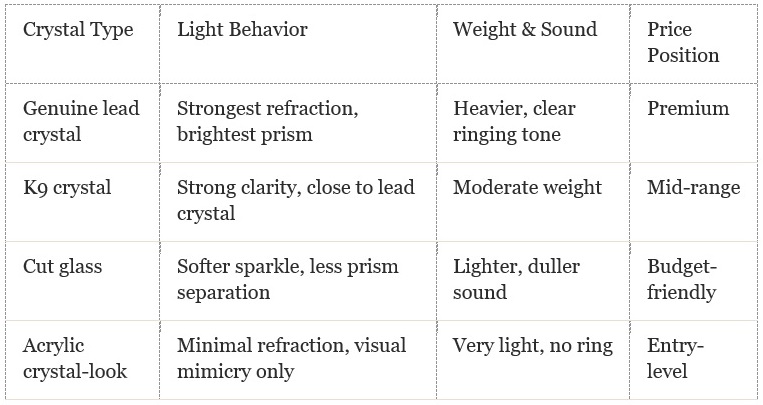
The Crystal Types Actually Behave Differently
Finish Sets the Personality More Than the Crystal Does
This surprises people once they compare fixtures side by side: the metal frame finish behind the crystal does more to set the mood than the crystal itself. Gold and brass push the piece toward warm and traditional. Chrome and polished nickel cool everything down and read as sharper, more modern. Matte black is the one that surprises most people — dark, almost industrial metalwork paired with bright faceted crystal creates a contrast that feels current in a way that didn't exist a generation ago.
A quick gut check before buying
Stand in the room at the time of day you'll actually use it — evening, probably, for a dining or living room — and picture the fixture lit and dimmed low. If you can picture light moving and breaking apart rather than just glowing flatly, that's the crystal effect doing what it's supposed to do. If the room is very bright, very minimal, and rarely dimmed, a denser crystal piece may end up looking busy rather than dramatic.
Where This Leaves You
Crystal chandeliers aren't the right call for every room, and anyone telling you otherwise is selling something. But the reputation they've picked up — fussy, dated, only for formal dining rooms — doesn't hold up against what's actually being made. The category has quietly modernized while a lot of the conversation around it stayed stuck in an older idea.
If you're weighing one for a dining room, foyer, or stairwell and want to see how the modern end of the category actually looks — the ring frames, the linear bars, the spiral forms that don't resemble your grandmother's dining room at all — Modern Chandelier's crystal chandeliers collection is a reasonable place to start comparing finishes and silhouettes.
Frequently Asked Questions
Do crystal chandeliers work in modern homes?
Yes, but the specific piece matters. Open ring or geometric frames with sparse crystal, especially in matte black or chrome, read as contemporary. Dense tiered designs in polished brass lean traditional. The crystal itself isn't what dates a fixture — the frame and density are.
How much more maintenance do they really need?
More, but not dramatically so. A light dusting every couple of weeks and a thorough cleaning two or three times a year cover most households. The amount of upkeep scales with density — a sparse ring takes a fraction of the time a heavily tiered piece does.
What's the real difference between crystal and glass?
Genuine crystal contains lead, which gives it sharper refraction and a clearer light-scattering effect than ordinary glass. It's also heavier and produces a distinct ringing tone when tapped. Visually, crystal throws more defined light fractures; glass diffuses more softly.