

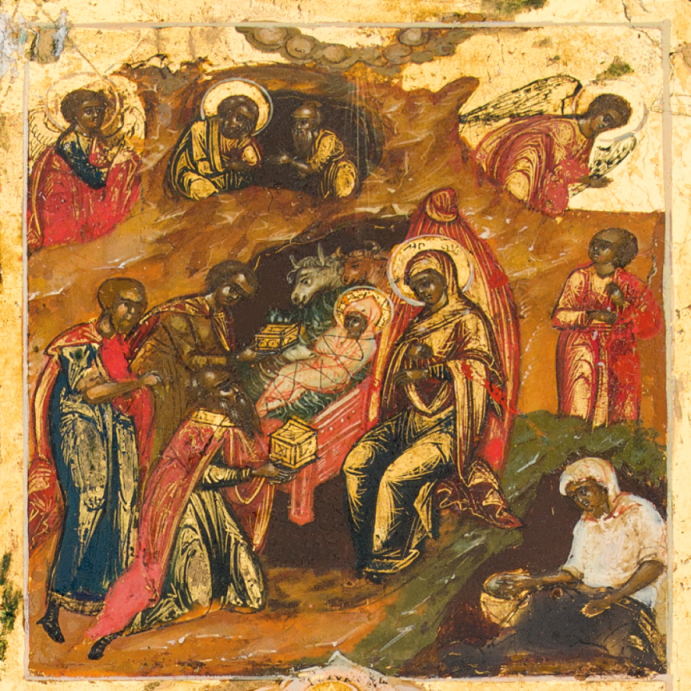
Though many centuries have passed since their creation in the Novgorod, Moscow, and Palekh workshops, antique Russian icons continue to attract serious attention from auction houses, museums, and private collectors worldwide. Their lasting value is based on four key factors: cultural significance, rarity, condition, and collector demand.
Cultural Value of Antique Russian Icons
Russian icons are much more than paintings. They occupy a unique place in art history as religious objects of veneration, created according to strict canonical traditions that originated in Byzantium after the Christianization of Rus in 988. Each icon preserves centuries of theological thought while reflecting the diversity of regional artistic traditions: Novgorod’s bold simplicity, Moscow’s refined elegance, and the jewel-like decorative details associated with the Stroganov school.
Beyond their spiritual meaning, icons provide valuable insight into the development of Russian art, craftsmanship, and cultural identity. Their visual language, symbolism, and techniques continue to inspire researchers and collectors who appreciate both their historical importance and artistic qualities.
Rarity: The Factor of Shrinking Supply
The number of antique Russian icons available on the market continues to decrease over time. Wars, fires, and decades of Soviet-era destruction of religious heritage significantly reduced the number of surviving works. Icons created before the 17th century are especially rare, with many exceptional examples preserved in museums and only occasionally appearing at auctions.
Modern export restrictions and regulations concerning cultural heritage have further limited the availability of Russian icons on the international market. As a result, well-documented examples already held in Western collections have become increasingly valuable among collectors seeking historically significant works.
Condition: Where Value Rises and Declines
Historically, icons served as active objects of devotion. They were kissed, carried during religious processions, and exposed to candle smoke and environmental changes inside churches. Over time, these factors affected the condition of wooden panels, gesso grounds, and paint layers. Additional damage was sometimes caused by inexperienced restoration attempts or inappropriate conservation methods.
For this reason, condition plays a crucial role in evaluating icons today. Collectors and specialists carefully examine the stability of the wooden panel, the preservation of original paint layers, the presence of a kovcheg, and original decorative elements such as silver-gilt oklads.
Collector Demand in the Global Market
Demand for icons has remained strong among collectors around the world. Antique Russian icons attract Orthodox communities, Russian art enthusiasts, and international collectors who recognize their aesthetic significance and historical value.
Specialized collections, such as Oleg Kushnirskiy’s icon collection presented in a comprehensive catalog, have contributed to the growing visibility of Russian icons in the global art market. Works with imperial connections, documented provenance, or clear workshop attribution remain especially desirable, securing Russian icons a respected place in contemporary collecting.