


A crate leaves a Chelsea gallery at 7 a.m. The driver has a noon delivery window in their head. The receiving registrar blocked off 9 a.m. The collector was told Thursday. Nobody lied. Everyone simply worked from a different version of the same shipment.
Fine art logistics runs on handoffs. Packers pass to drivers, drivers pass to installers, coordinators pass to customs brokers, and all of them answer to the client paying the invoice.
Every transfer point is a place where details fall out: crate counts, elevator dimensions, climate requirements, loading dock hours, signature authority.
The financial damage is documented. Ineffective communication costs U.S. businesses up to $12,506 per employee, per year, and 66% of customers who moved to a competitor in 2026 said poor communication from company representatives drove the decision.
Crating skill and art transportation tips matter enormously, though coordination failures ruin work that no amount of glassine can protect.
Where Art Shipping Communication Breaks Down Most Often
Failures cluster around a few predictable moments:
- Booking: dimensions, weight, and value get quoted from memory instead of a measured worksheet.
- Pickup: building access and parking permits go unconfirmed until the truck is double-parked.
- Transit: delays and temperature alerts stay locked in one driver's phone.
- Delivery: nobody on site knows who is authorized to sign.
- Aftermath: damage gets reported verbally, then disputed weeks later.
The consequences can be permanent. In 2000, a Lucian Freud still life arrived at Sotheby's London and was mistakenly placed in the warehouse zone where empty crates await disposal. Two workers fed the case into a crushing machine, and the error surfaced only when staff reviewed security footage after the work failed to reach the saleroom.
Instant Voice Contact Between Warehouse, Truck, and Site
Email and text create lag exactly when speed matters most. A handler holding a Calder in a loading bay needs an answer in seconds, not after a thread refreshes.
With push-to-talk solutions, such as Peak PTT's radios, the entire channel hears the call live, and every transmission is recorded for instant playback. The packer, the driver, and the installer get identical wording at the same moment.
Because the devices transmit over multi-carrier LTE and Wi-Fi instead of repeaters, a Brooklyn warehouse and a Palm Beach residence sit on the same channel.
The whole team hears the same instruction simultaneously, which matters when 46% of people report missing messages because of communication problems inside their business. Live voice removes the guesswork about who saw what.
Condition Reports Both Sides Confirm Before Anything Moves
Insurers see this pattern constantly. In one documented claim, a collector consigned a sculpture and personally supervised the crating, fastening the piece inside a crate marked fragile with the top end indicated. The work returned in a larger crate, wrapped in bubble wrap and packing peanuts, broken into three pieces.
The gallery explained that the original crate had been discarded, forcing staff to improvise with whatever materials were available. A signed condition report at every transfer point converts that conversation into evidence. Photograph the front, back, corners, and frame. Note existing marks. Secure a countersignature before the truck pulls away.
One Shared Record for Every Shipment Handoff
Where does the truth live when a claim gets filed six weeks later? Verbal confirmations evaporate; written ones survive. Keep one document that travels with the shipment and updates at each stage.
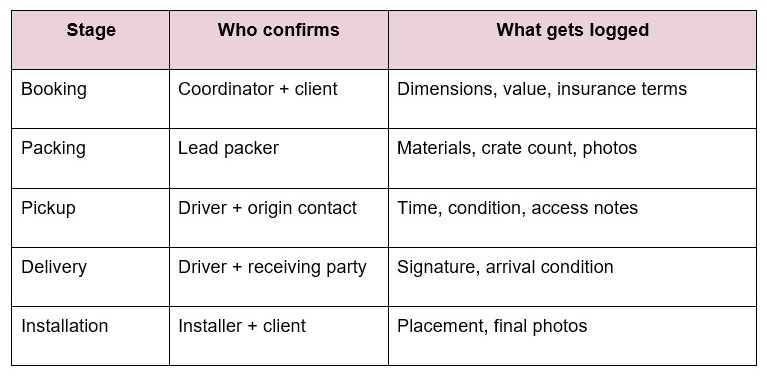
Information scattered across inboxes, group chats, and spreadsheets turns valid claims into denied ones. One record, one version, every party reading the same line.
Client Updates That Protect Repeat Gallery Business
What does a collector remember six months after a delivery? Rarely the crate construction. They remember being told, or not told, that the truck was running four hours behind. Proactive updates cost minutes and buy years of repeat work.
- Confirm the booking in writing within one business day.
- Send a departure notice with a realistic arrival window.
- Flag delays before the client discovers them independently.
- Deliver installation photos the same afternoon.
Silence reads as trouble. Registrars and gallery directors keep working with shippers who make them look organized in front of their own clients. Steady updates remain the cheapest way to earn that reputation, and avoiding shipping nightmares often means answering questions before anyone asks them.
Clear Channels Belong in Every White Glove Service
Custom crating, climate control, and nail-to-nail coverage get the attention they deserve. Yet many transportation errors that end in ruined work and lost accounts started with a single assumption nobody verified. Define who speaks to whom at each stage.
Give crews a channel that functions from a warehouse basement to a fairground tent. Write down what was agreed and confirm it back to the client. Treat the talking as carefully as you handle the canvas, and the shipments largely take care of themselves.