

U.S. parcel volume hit 22.37 billion shipments in 2024, up 3.4% year over year, and Pitney Bowes expects another 36% growth by 2030. Meanwhile, UPS and FedEx, the traditional backbone of e-commerce logistics, keep raising rates and stacking peak surcharges across 2025 and 2026. UPS announced 20,000 layoffs and walked away from a chunk of low-margin Amazon shipments, while in Q1 2026, Amazon overtook USPS in parcel volume and captured 28% of the market. The parcel duopoly is cracking. However, true e-commerce sustainability does not start with the local mail carrier; it begins with first-mile international freight optimization, where the core product margin is actually established before goods ever reach a domestic fulfillment center.
Rate cards and peak surcharges sit at the surface. Underneath, U.S. merchants are dealing with three structural shifts in 2026: the move from 5-day to 7-day operations as the new delivery promise standard, eligibility-based pricing for lightweight parcels that bypasses legacy dimensional minimums, and the rise of market-driven price discovery layered on top of global logistics networks. Below, we'll unpack what the coast-to-coast OnTrac × ShipStation integration announced on January 6, 2026, actually means, how multi-carrier hubs are reshaping the unit economics of e-commerce delivery, and where an international logistics marketplace and digital freight exchange like AiDeliv.com fit into this architecture.
The Seven-Day Advantage: How 7/7 Beats Legacy Networks
7-day e-commerce shipping sounds straightforward. For SMBs and 3PLs, it's a different economy entirely. Today's U.S. shopper treats a two- to three-day delivery window as the default floor. Anything slower reads as a red flag, both at checkout and on repeat purchases. Through the expanded OnTrac integration inside ShipStation, sellers gain coast-to-coast reach across 75%+ of U.S. shoppers and 48 of the top 50 U.S. metros, with pickup, transit, and delivery running seven days a week without pauses. OnTrac itself claims shippers save 10–35% versus national and postal carriers, thanks to fewer surcharges and a more predictable price structure.
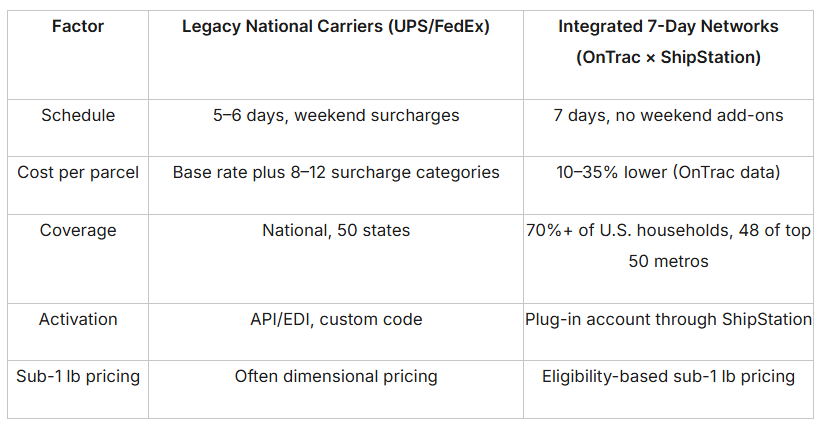
Parcel carrier integration at this scale is becoming the standard playbook for merchants in 2026. For SMBs, it means fewer cart abandonments and a lighter WISMO ticket load. For 3PLs, it means higher hub throughput because cardboard isn't sitting around waiting for Monday. Either way, a seven-day setup hands back control over the delivery promise without forcing capital investment into a captive last mile.
Integrating Tech and Network: Where Margin Lives
ShipStation runs as a multi-carrier hub with 400+ integrations, including USPS, UPS, FedEx, GlobalPost, Amazon, Shopify, BigCommerce, and now OnTrac at full capacity. Under the hood, the platform handles automated rate shopping, inventory management, returns and exchanges, and analytics. Tens of thousands of e-commerce businesses already run through it as a single control plane. A merchant connects an OnTrac account through the native connector and immediately sees which rate works best for a given parcel, no separate TMS project, no custom code.
Top 4 Advanced Shipping Tools for Modern Merchants
- Automated rate shopping: matches carrier and service to each order based on zone, weight, and SLA.
- Delivery Instruction API: custom delivery rules (signature, drop-off locations, contactless) at the individual shipment level.
- Eligibility-based sub-1 lb pricing: a dedicated rate grid for lightweight parcels that bypasses dimensional minimums.
- Trailer Manifest Scanning and 3P Marketplace Shipping: for marketplace sellers with broad SKU mixes.
In this architecture, a digital freight exchange becomes the logical next layer to secure the upstream supply chain. Platforms like AiDeliv let merchants post international shipments (Ocean FCL/LCL or Air Freight), where carriers on the platform deliver through real-time bids. Once a carrier wins the auction via AiDeliv's patent-pending reverse auction technology, the market-driven rate locks in automatically, ensuring comprehensive landed cost optimization is visible before order confirmation. Per AiDeliv's public data, a sample of 3,147 auctions in Q4 2025 showed per-shipment freight cost savings of 15–40% versus baseline rates. Furthermore, bundling international freight volumes through demand aggregation helps SMBs gain large-scale shipping leverage long before last-mile sorting begins.
Winning the Margin War: How Eligibility-Based Services Work the Bottom Line
The defining shift in 2026 domestic parcel economics is eligibility-based pricing. OnTrac's sub-1 lb pricing unlocks for merchants who meet specific shipper eligibility criteria, and that's exactly where the line between marginal-positive and marginal-negative SKUs gets drawn. A cosmetics brand or add-on accessories seller shipping 0.4–0.9 lb parcels often pays the 1 lb rate in legacy networks because of dimensional minimums. In an eligibility-based grid, that same last-mile parcel hands back a few cents per unit. Across a full year, those cents compound into six-figure savings. Custom delivery instructions delivered through API trim re-deliveries and WISMO tickets further, while Trailer Manifest Scanning and 3P Marketplace shipping add SKU-level visibility for high-velocity catalogs and FBM operations.
“OnTrac's seven-day coast-to-coast operations paired with ShipStation's advanced technology give shippers another option to access fast delivery and unlock cost savings… Together, we're giving merchants a proven alternative for fast delivery, broad reach, and measurable efficiency without added complexity.” — Vijay Ramachandran, VP of Marketing, Product Strategy & Marketplaces, OnTrac (Press release dated January 6, 2026).
Shipping choice for merchants is becoming an orchestration play across several distinct logistics layers managed through an integrated software ecosystem.
Conclusion: Flexibility as a Scalable Edge
Seven-day shipping no longer reads as a premium option. By late 2026, it's the default for what merchants promise customers and what domestic last-mile carriers must deliver to stay in the game. Merchants stuck inside traditional, rigid contracts bleed margin at both ends of the supply chain. The ultimate winner in modern e-commerce is the merchant who controls the full stack: from locking in market-driven international freight rates on AiDeliv to executing flawless 7-day last-mile delivery via integrated domestic hubs. In 2026, agility across the entire line-haul is the only strategy that pays off.