


Art collectors and interior designers have a particular reason to pay attention to home elevators, and it has little to do with mobility alone. A three-story home filled with sculpture, framed canvases, and antique furniture presents a real logistics problem the moment something needs to move between floors. Staircases are unforgiving to anything fragile, oversized, or heavy, and even the most careful moving crew can only do so much when a piece has to be carried up two flights by hand. A well-planned elevator solves that problem permanently, and it happens to be one of the fastest-growing features in high-end residential design.
Why vertical homes are driving the trend
The shift is not just anecdotal. Vertical homes are becoming standard in markets where land is scarce and prices are high, and architects have responded by building up rather than out. Coastal California, South Florida, and the Northeast are seeing three- and four-story custom homes at a pace that would have been unusual a decade ago. Professionals who work with hillside properties, including the kind found across the Bay Area, know this shift well. For homeowners weighing the investment, the best home elevator for Bay Area hills often comes down to matching the system to the site, since a steep lot changes what installation options are realistic.
Choosing the right elevator system
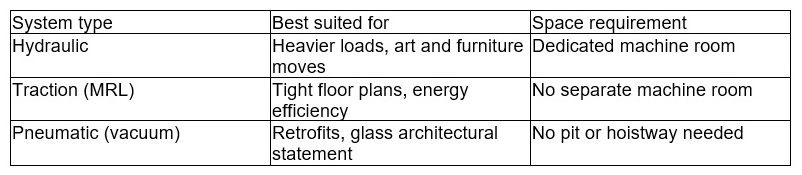
Three main systems dominate the US market right now, and each suits a different kind of home. Hydraulic elevators use a pump and piston, run quietly, and handle heavier loads well, but they need a dedicated machine room, which matters if a lower level is already earmarked for wine storage or a private gallery. Machine room-less traction elevators skip that requirement entirely, relying on a counterweight and cable system that fits into tighter floor plans. Pneumatic, or vacuum, elevators are the newest option on the market and use air pressure to move a circular glass cab, requiring no pit or hoistway at all, which makes them the easiest system to retrofit into a home that was never designed with an elevator in mind.
Safety codes and resale value
Safety codes have caught up with the surge in demand, and that matters for anyone advising a client on a purchase. Residential elevators in the US fall under the ASME A17.1/CSA B44 code, and one of the more consequential recent updates is the so-called three-part four-inch rule, designed to close the gap between the hoistway door and the car door so small children cannot become trapped. According to GIS user technology news, real estate professionals report that a properly installed residential elevator can raise a home's resale value by ten to fifteen percent, largely because it opens the property to buyers who would otherwise rule out a multi-story layout entirely.
From utilitarian box to architectural feature
Design has moved just as fast as the technology behind it. A decade ago, home elevators were treated as utilitarian boxes tucked behind a closet door, something to be hidden rather than shown. That has reversed almost completely. Glass cabs, custom millwork that matches existing crown molding, and brushed metal finishes now turn the elevator into a genuine architectural feature rather than an afterthought. For a collector building a private gallery across several floors, that shift matters twice over, since the elevator itself can become part of the visual experience of moving through the house.
Coordinating with art logistics from the start
None of this replaces the basics of safe art handling once a piece is inside the cab. Weight limits still apply, and a hydraulic system rated for household goods is not automatically rated for a marble bust or an oversized canvas in a rigid crate. Anyone integrating an elevator into a home built around a serious collection should loop in both the elevator installer and an art logistics team early, since clearances, door widths, and load capacity all need to be checked against the actual pieces that will travel through the space. This is the same kind of coordination that matters when choosing security doors for a home's interior, where the design decision and the practical one have to be solved together rather than in sequence.
A feature for multi-generational households too
Multi-generational households add another layer to the decision. Adult children caring for aging parents are increasingly building homes with an in-law suite on an upper floor, and an elevator is what keeps that arrangement functional day to day rather than just on paper. The same logic applies to anyone planning to age in a home they love rather than downsizing out of it. A residential elevator removes the one obstacle, the staircase, that eventually forces so many people out of houses they would otherwise stay in for decades.
Protecting the investment on every floor
For a home that already carries significant value in its art and furnishings, a well-chosen elevator is not an indulgence. It protects the investment sitting on every floor, it expands who can eventually buy the house, and it lets a family use every square foot for as long as they own it. The systems on the market in 2026 are quieter, more efficient, and far better looking than anything available even five years ago, which makes this a good year to have the conversation.