


Cross-country art shipping can take three to six days by dedicated truck or several weeks via a shared route. Choose a reliable carrier, document each piece carefully, and confirm insurance coverage. Professional art shippers use trained handlers and customize packing and transportation methods to meet each artwork’s specific requirements.
How long does cross-country art shipping take?
A dedicated truck often takes three to six days; shared shipments can take weeks because the truck serves several clients and may store pieces between legs. Pickup is usually scheduled within a few days.
Confirm pickup timing, storage, tracking, and delay procedures. Put fixed deadlines in the contract if possible and ask about destination storage.
Which art shipping service fits your piece?
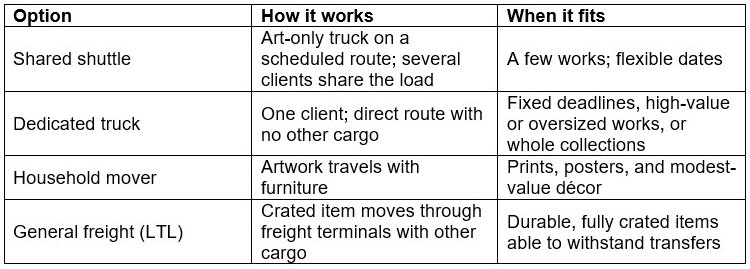
When the quote is for a regular freight truck
General freight or a household mover may suit a sturdy crate. For canvas and works on paper, ask who packs and loads it, whether the crew has art experience, whether terminals or forklifts are involved, what temperature the trailer maintains, and what liability and extra coverage cost.
Avoid carriers that cannot explain securement or coverage, or leave packing entirely to you. The contract or bill of lading should list each piece, inventory number, addresses, dates, declared value, coverage, and instructions such as “upright only.”
What needs to be ready before pickup?
Prepare a condition report, photos, inventory number, and value for each piece. Photograph all sides, labels, and existing damage (raking light can reveal lifting paint). For important works, hire a conservator; otherwise, handlers may prepare the report at pickup. Review and sign it with the crew.
Match package numbers to the inventory, including dimensions and weight. Keep an appraisal or invoice for the declared value. Measure doors, stairs, and elevators against packed dimensions. Reserve loading docks or service elevators and arrange required insurance certificates.
Does every painting need a crate?
No. Packing depends on condition, journey length, and handling. Soft packing suits sound framed works; a travel frame holds canvases by their edges. A custom foam-lined crate suits fragile sculpture, vulnerable panels, multi-stage shipments, or storage, but adds weight, cost, and preparation time.
Leave valuable originals to professionals. Ask a conservator about flaking paint, tears, or weak stretchers. Bubble wrap must not touch painted surfaces. For works under glass, ask about taping and glass protection. Pastels and charcoal may need to travel flat and face up.
How are artwork and crates protected in transit?
Ask how the work will travel and be cushioned. Paintings usually travel upright, separated by padding; soft-packed works go in padded racks. Crates are secured to metal track with heavy-duty ratchet tie-down straps over edge protectors.
Straps secure the crate; internal foam and bracing keep the artwork still. Ask about anchoring, pressure, and vibration. Federal cargo rules (49 CFR Part 393) cover freight securement, not art handling.
What climate control does and doesn't cover
Climate-controlled often means heating and air conditioning, not humidity control. Stable temperature may suit framed works in good condition; works on paper, photographs, panels, and veneered furniture are more moisture-sensitive. Ask for temperature and humidity ranges, monitoring, and access to readings.
What does the carrier's insurance actually cover?
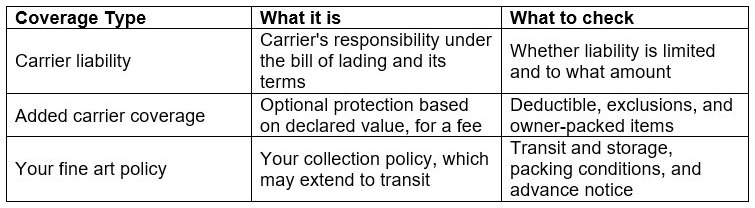
Under the Carmack Amendment, carriers on covered interstate shipments are liable for loss or damage but may limit their liability under agreed conditions. Basic carrier liability may be far below the artwork's value. Declaring a value does not guarantee full compensation; claims require supporting evidence, including the pickup condition report and, in some cases, a conservator's assessment.
Your policy may also impose specific notice requirements. Ask your broker whether coverage is door-to-door, whether packing conditions affect protection, which policy pays first, and what documentation is required in the event of a claim.
When the truck arrives
Confirm whether white glove delivery includes carrying the work inside, unpacking, and removal of packing; art hanging may cost extra. Compare each piece with pickup photos while the crew is present. Record new damage specifically on the delivery receipt.
Receiving artwork after cold-weather transport
Conservation guidance suggests leaving a cold, packed painting closed for about 24 hours to warm gradually and avoid condensation. This is a guide; timing depends on package temperature and room humidity.
Photograph the crate at delivery, write “contents not inspected” on the receipt, and arrange a return visit to unpack if possible. Agree with the carrier and insurer beforehand; the note alone does not guarantee compensation.
If you find damage
- Stop unpacking; photograph the artwork, inner packing, and crate as found.
- Keep every packing material for a possible inspection.
- Notify the carrier in writing immediately, attaching photos and the signed receipt.
- Contact your broker and request a conservator’s written assessment.
- Do not attempt repairs yourself.
Before you sign the contract
- Confirm the pickup window, delivery dates, and any storage.
- List every piece with its inventory number and declared value.
- Record handling instructions and climate range if needed.
- Confirm transit coverage with your broker in writing.
- Arrange loading docks, elevators, and insurance certificates at both addresses.