


Understanding when white glove delivery is necessary can help businesses and private collectors choose the right level of shipping service for valuable, fragile, oversized, or complex items. White glove delivery is a specialized service in which trained professionals transport an item, bring it inside, unpack it, assemble or install it when needed, and remove the packaging and debris.
Unlike standard shipping, which typically ends at the recipient’s door, white glove service covers the final stages of delivery. This makes it particularly useful for artwork, antiques, large furniture, sculptures, appliances, and other items that require careful handling or professional installation.
However, white glove delivery is not necessary for every shipment. Because the service costs more than standard transportation, understanding the specific risks and handling requirements can help you decide whether the additional service is justified.
When White Glove Delivery Is Necessary vs. Optional
The need for white glove delivery depends primarily on an item's value, size, weight, fragility, installation requirements, and destination conditions.
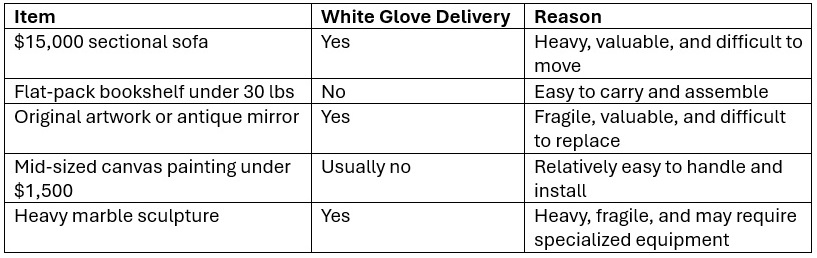
This table provides general guidance rather than a universal rule. The appropriate service level can change depending on the item's dimensions, construction, access conditions, and installation requirements.
Common Use Cases for White Glove Delivery
White glove delivery is particularly useful for:
- High-value items that would be difficult or expensive to replace.
- Oversized or heavy objects that require multiple handlers or specialized equipment.
- Fragile artwork and antiques that need careful handling and positioning.
- Environmentally sensitive artwork that requires controlled handling and acclimatization.
- Luxury furniture and interior objects that require room-of-choice placement or assembly.
- Appliances and specialized equipment that require professional installation.
- Deliveries with difficult access, including narrow staircases, elevators, or restricted loading areas.
In general, knowing when white glove delivery is necessary starts with weighing the risks and complexity of handling an item against the additional cost of professional service.
White Glove Delivery vs. Standard Shipping
The primary difference is the level of assistance provided at the destination.
Standard shipping generally delivers an item to the doorstep or another accessible location. The recipient is usually responsible for carrying it inside, unpacking it, assembling it, and disposing of the packaging.
White glove delivery extends beyond transportation. Depending on the service package, professionals may bring the item to a specific room, unpack it, assemble or install it, position it, and remove the packaging materials.
FAQs
What is the cost of white glove delivery?
The cost depends on the item's size, weight, value, distance, access conditions, and services required. Simple deliveries may cost a few hundred dollars, while oversized, complex, or long-distance projects can cost significantly more.
What is the difference between white glove delivery and standard shipping?
Standard shipping generally ends at the delivery point. White glove service includes additional handling at the destination, such as room-of-choice delivery, unpacking, assembly, installation, and packaging removal.
Is white glove delivery necessary for e-commerce sales?
Not always. It is most useful for high-value, fragile, oversized, or complex products where professional handling can reduce the risk of damage and improve the customer experience.
Is white glove delivery worth the cost?
For valuable or difficult-to-handle items, it often is. The additional cost can be justified when it reduces the risks of property damage, personal injury, improper installation, returns, or damage claims.
In short, white glove delivery is most appropriate when an item's value, fragility, size, weight, or installation requirements make standard doorstep shipping impractical or risky.