

Designing a room around an art collection works best in one order: measure the art, give each piece a wall, then choose furniture to fit the space that's left. When the sofa comes first, a favorite canvas often lands behind a door swing, in afternoon sun, or on a wall too weak to hold it.
Start with a collection inventory
Record every work's framed width, height, depth, weight, and medium. Then add the pieces you expect to buy in the next year or two, because collections outgrow rooms quickly. In the Art Basel and UBS Survey of Global Collecting 2025, the 3,100 high-net-worth collectors surveyed spent an average of $438,990 on 14 works.
Leave at least one wall unassigned for new arrivals. If you rotate works often, a rail or track system from this guide to museum hanging systems saves you from patching holes every season.
Measure usable wall space
A 14-foot wall rarely gives you 14 feet for art. Subtract doors and their swing, windows, radiators, vents, switches, and outlets, then measure the clear width between obstacles. As a starting point, keep about 12 inches of bare wall on each side of a frame so it doesn't crowd a door casing or corner.
Heavy pieces also need a wall that can carry the load. The advice on hanging oversized artwork safely covers fixings and wall types.
Check light wall by wall
The Canadian Conservation Institute explains that damage equals light intensity multiplied by exposure time, so 200 lux for 200 hours harms a painting as much as 100 lux for 400 hours. Lux is the unit for how much light falls on a surface.
Sensitivity depends on the medium. Conservation guidelines treat about 50 lux as the ceiling for the most light-sensitive works, such as works on paper, watercolors, and photographs, while oil and acrylic paintings tolerate more.
In practice, works on paper go on walls that never get direct sun. Check each candidate wall with a lux meter at midday and late afternoon, and read up on UV-filtering glazing.
Plan sightlines from the door and the main seat
Pick the two viewpoints that matter most: the doorway and the seat you use every evening. Your strongest piece should be visible from both.
Then size the furniture to the art. The usual rule says a painting should be about two-thirds the width of the sofa below it. With a collection, work backward from the canvas: a 60-inch painting suits a sofa of roughly 84 to 90 inches. Hang the center around 57 to 60 inches from the floor, raised enough to clear the sofa back by 8 to 10 inches.
Give sculpture and large works room
A freestanding sculpture needs a clear floor on every side people will walk on; about 36 inches for a main path is a common planning width. Keep plinths away from door swings and busy corners.
Check the delivery route before you commit to a spot. Measure the front door, hallway turns, stairwell, and elevator against the largest piece in its crate, since crating adds width and depth to every dimension.
Test the layout in 3D before installation day
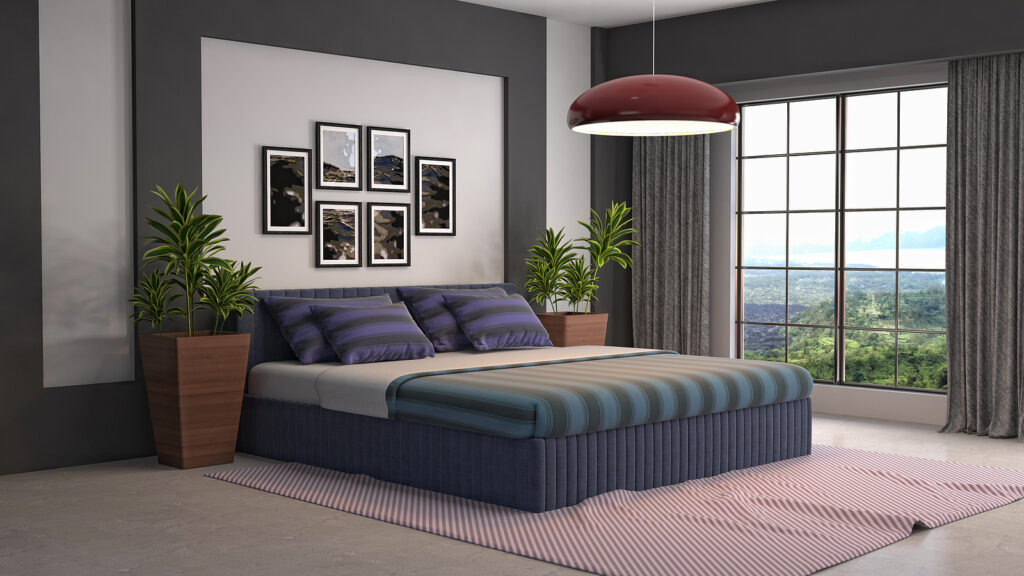
A to-scale model catches these problems before a nail goes in. Arcadium offers a free 3D room design tool that works in browsers, and it is quick to pick up even without computer-aided design (CAD) experience.
Type in the wall lengths, place doors and windows with their real swing, then add each artwork as a panel at its exact framed size. Set the sofa and tables to the sizes you plan to buy, and every change shows in 3D as you make it.
The dimension tool confirms whether the path around a plinth really measures 36 inches. The daytime, golden hour, and night lighting modes show which walls catch low sun, which is worth confirming with a lux meter. A first-person walkthrough at eye level shows whether the main piece reads from the doorway and the sofa.
Once the layout works, export dimensioned wall elevations as a PDF for the installation team, or send a link so your installer or designer can walk through the room in a browser.
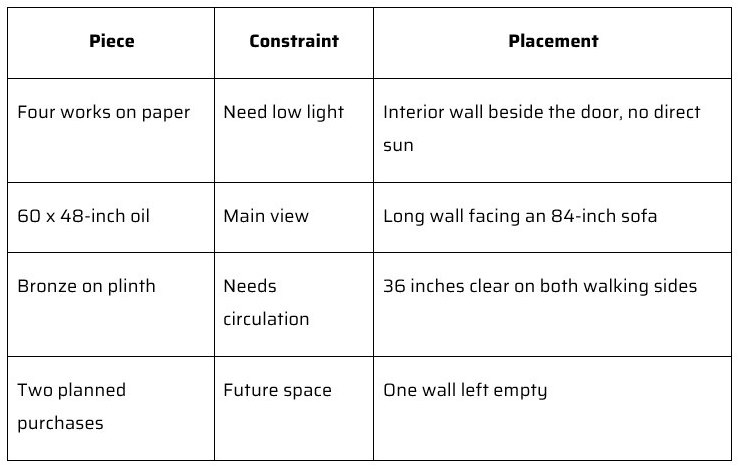
Example scenario: a 16-by-20-foot living room with a south-facing window, nine works, and a bronze.
Your next step
Before you buy another piece of furniture, measure your three largest works and the walls you'd hang them on, and write both lists on one page.