

Why canvas paintings warp is a common question among art owners and collectors. Canvas warping occurs when a painting loses its original flat plane because the fabric becomes too loose or too tight, or because the wooden stretcher beneath it changes shape. In some cases, warping appears as ripples, corner draws, or a stretcher that no longer sits flush against the wall. Understanding the causes of canvas warping can help prevent permanent damage.
Why Canvas Paintings Warp: The Moisture Question
Moisture is one of the primary factors behind canvas warping. Both the fabric used for the canvas and the wooden stretcher beneath it are hygroscopic, meaning they absorb and release moisture from the surrounding air. As relative humidity changes, these materials expand and contract at different rates.
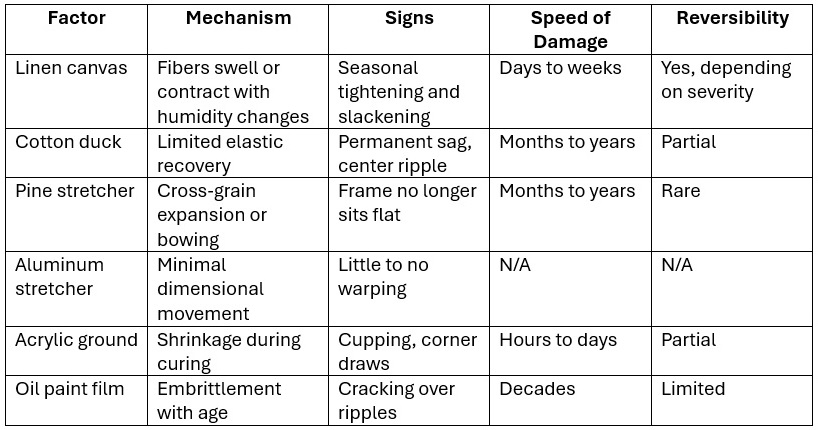
Stretcher bar movement can also result from moisture fluctuations. Wood expands more across the grain than along it and can bow when one side gains or loses moisture faster than the other. Repeated changes in humidity can gradually affect canvas tension and contribute to sagging, rippling, or deformation.
Comparison of Warping Processes by Material
How to Prevent Warping?
Understanding why canvas paintings warp is the first step toward effective prevention. Experts recommend the following precautions:
- Keep relative humidity (RH) within approximately the 40–55% range and avoid rapid fluctuations.
- Choose kiln-dried, knot-free, or aluminum stretcher bars for large-scale artworks.
- When stretching canvas, staple from the center of each side outward, alternating between opposite sides to maintain even tension.
- Add cross braces for larger artworks, particularly those exceeding 35 inches on any side.
- Hang artwork on interior walls, away from windows, exterior walls, radiators, and other sources of temperature or humidity fluctuations.
- Store paintings vertically when appropriate, with adequate support and spacing between works.
FAQs
Can a warped canvas be repaired?
Yes, many cases of canvas warping can be corrected, but the appropriate treatment depends on the cause and severity of the deformation. Minor slackness may sometimes be corrected by carefully adjusting the stretcher keys. More severe warping may require professional re-stretching or conservation treatment.
Why does my canvas ripple or become tighter as the seasons change?
Seasonal changes in relative humidity can cause canvas fibers and wooden stretcher bars to expand and contract. These changes affect the tension of the canvas and may result in temporary rippling or tightening. The goal is not to eliminate all movement but to minimize significant environmental fluctuations.
What is the difference between stretchers and strainers?
Stretchers have expandable corner joints and keys that allow canvas tension to be adjusted. Strainers have fixed joints and cannot be expanded to compensate for canvas slackening. For artworks that require future tension adjustments, stretchers are generally more flexible.