


When an office relocation comes in, a commercial mover needs more than an address and a date. Elevator reservations, loading-dock access, IT equipment, and after-hours work can all change the crew and equipment required. The same details should shape the way you evaluate a Google Ads partner. A campaign that brings in plenty of inquiries can still leave your estimators chasing work your crews cannot take.
Start with the commercial jobs you want more of. Write down the markets you can serve, the size and types of offices you can move, and how far in advance you need to book. A guide to planning an office move without downtime can help you turn the customer's logistical constraints into questions for your intake team.
Ask how the campaigns will separate office moves from household moves
Have the provider show you how it would group searches for office relocation, commercial movers, and residential moving. Ask which services would get separate campaigns or landing pages and who would review search terms each week. If you handle commercial relocations but lack storage or IT installation, the agency should know when to exclude those searches and when they indicate a larger job you can still quote.
Check how the provider will handle geography. If your crew can move a company between two neighboring markets, specify which origin and destination combinations are profitable. A service description such as Wengy’s PPC page for moving companies can help you compare scope across proposals. Ask each provider to explain how it would set up a campaign for one of your actual routes.
Review the quote form with your estimator
Give prospects an easy way to share the origin and destination ZIP codes, move window, approximate office size, and any access restrictions. Let the estimator collect details like insurance certificates and building rules in the follow-up. A request for a move in downtown Boston, for instance, may involve building access windows and elevator reservations that affect whether you can serve it.
Decide who handles calls and forms after hours. Ask the ad partner how it will distinguish a missed call, a valid inquiry, an estimate, and a booked move. If the proposal includes Google Local Services Ads, ask how those inquiries and costs will be reported alongside Search Ads.
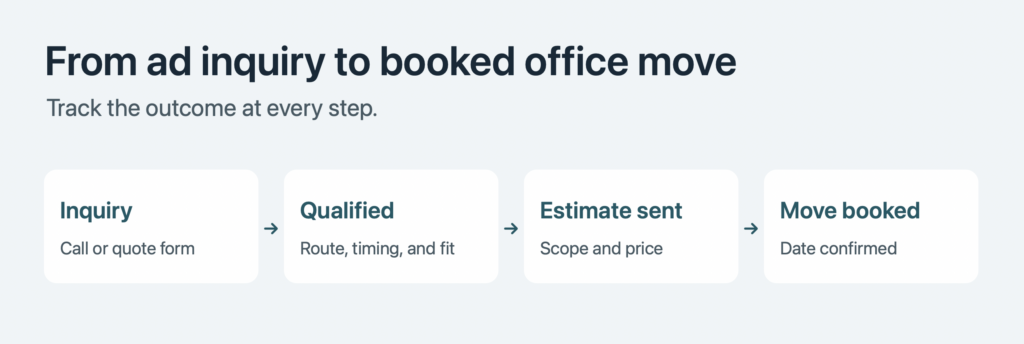
Compare proposals using cost per booked move
Ask for a reporting example that shows media spend, management fees, qualified requests, estimates sent, and bookings. In a hypothetical month, a mover spends $3,000 on ads, $1,500 on management, and $500 on tracking and landing-page work. Five booked office moves put the acquisition cost at $1,000 per move. If two later cancel, the cost rises to about $1,667 per completed job, assuming the remaining three go ahead.
Compare that figure with the contribution each job leaves after labor, trucks, equipment, and other delivery costs. Give commercial moves a reporting window that reflects the time between inquiry and booking, particularly if buyers need several quotes or sign-off from facilities management.
Agree on what the first review will cover
Before signing, agree who owns the Google Ads account, who can update the website, and how the mover will share booking outcomes. Set a date to review actual search terms, lead quality, and crew availability together. Use that review to decide which services or routes warrant more budget and which need changes to targeting, intake, or quoting first.