

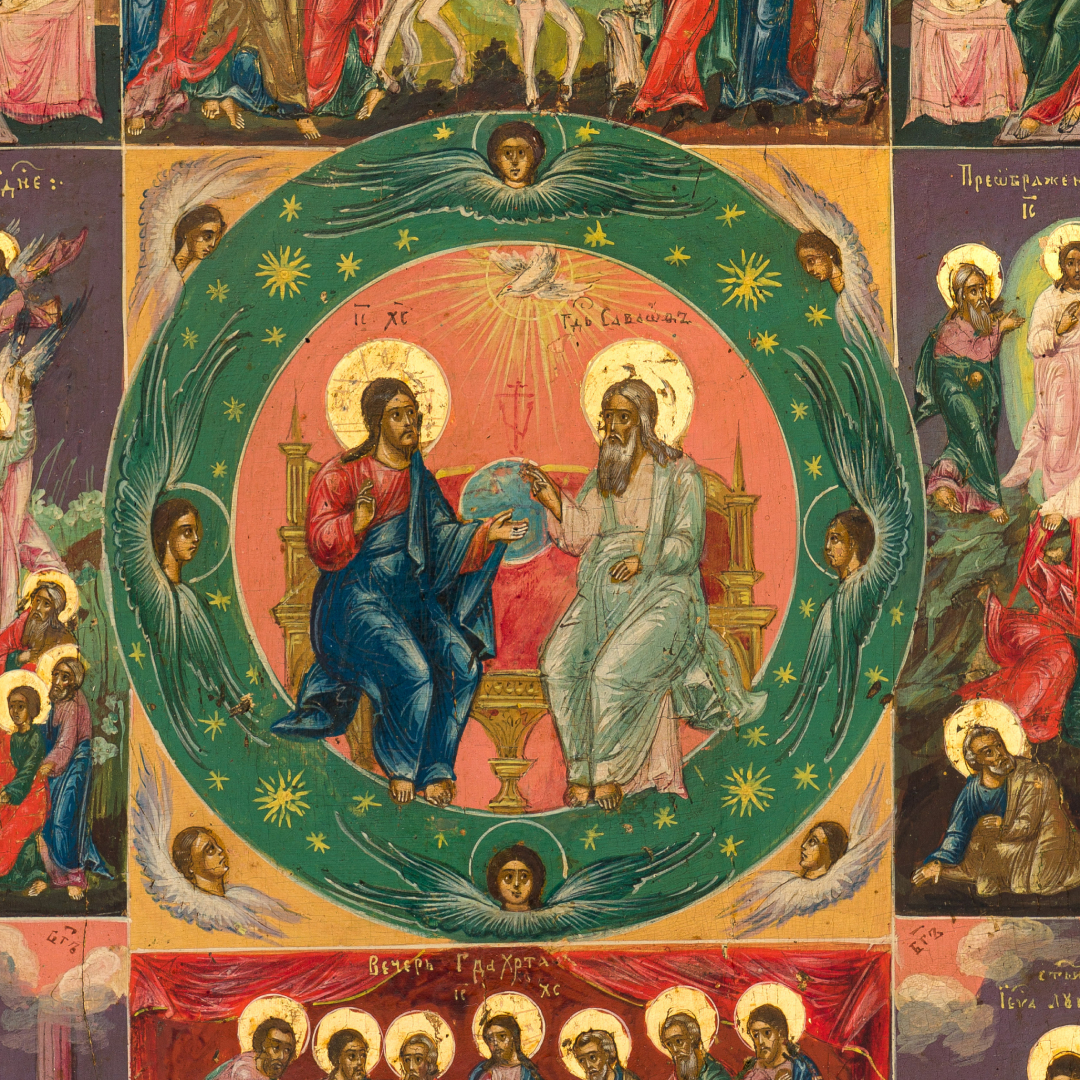
When Henri Matisse visited Moscow in 1911, he spent time studying Russian icons in private collections, museums, and churches. He was particularly impressed by the collection of Ilya Ostroukhov and by the vivid colors and spiritual intensity of early icons. Matisse’s encounter with this tradition was part of a broader revival of interest in Old Russian art that would influence the development of modern art and the Russian avant-garde.
Why Was Modern Art Influenced by Icons?
The growing interest in icons coincided with a new approach to their restoration. In the early 20th century, restorers began removing layers of darkened varnish and later repainting from medieval icons, revealing brighter colors and compositions beneath. Andrei Rublev’s Trinity, for example, underwent an important cleaning in 1904–1905, although further restoration work continued later.
The process helped change the way artists and the public viewed medieval Russian painting. A closer look at the history and symbolism of this tradition, as explored in Russian Icons: The Oleg Kushnirskiy Collection, helps explain why its visual language proved so compelling to modern artists. In March 1913, the Exhibition of Old Russian Art in Moscow presented cleaned 15th- and 16th-century icons to a large audience, contributing to a renewed appreciation of their distinctive artistic language.
Visual Language Borrowed from Religious Art
One important feature of icon painting that attracted modern artists was its alternative approach to pictorial space. In reverse perspective, lines may appear to expand toward the viewer rather than converge on a single vanishing point. This creates a sense of space that differs fundamentally from Renaissance linear perspective and places the viewer in a more active relationship with the image.
Flatness was another important characteristic. Rather than relying on conventional modeling, atmospheric depth, and naturalistic shadows, icon painters used simplified forms, frontal figures, strong outlines, and carefully organized surfaces. Modern artists found these qualities useful for moving away from academic naturalism. Natalia Goncharova’s The Evangelists (1911), for example, draws explicitly on the visual language of old icons and Old Believer art. The State Russian Museum identifies these sources as important influences on the work.
Color was equally significant. Icon painting uses color not simply to imitate nature but to organize meaning and create a spiritual atmosphere. This approach resonated with artists of the Russian avant-garde and had a lasting impact on modern art, including the work of Wassily Kandinsky and Natalia Goncharova. Kandinsky’s All Saints I (1911), for instance, belongs to a group of works in which religious and iconographic references coexist with increasingly abstract forms.
The influence of icons on modern art was therefore not limited to individual motifs. Their flattened forms, unconventional spatial logic, symbolic color, and emphasis on spiritual meaning offered artists an alternative visual system. By rediscovering this older tradition, modern painters found new ways to question realism and redefine what a painting could communicate.