

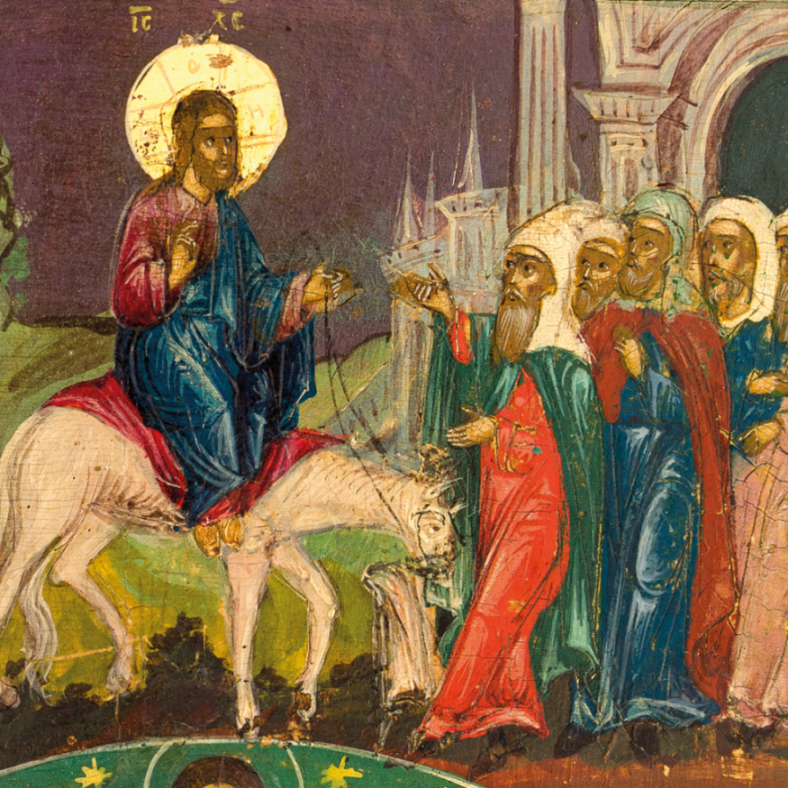
An Orthodox icon is more than a religious image; it represents a spiritual narrative through paint. Every element, including colors, gestures, objects, and inscriptions, belongs to a codified grammar, or language of icons, developed over centuries.
What Does the Language of Icons Tell Us?
Icons represent theology in a visual form that can be understood by those who learn to read it. Since many Orthodox believers were illiterate in the past, icons served as narratives that could communicate sacred stories without relying on words.
Color
Color carries meaning long before the figure is identified. Gold is not merely decorative but represents uncreated divine light, while blue signifies the heavenly and transcendent. Red can signify life, blood, and martyrdom, while white symbolizes purity and the light of Transfiguration.
Gesture
Hands can speak more than words in Russian icons. Christ’s raised right hand forms a blessing, with the fingers spelling the abbreviation of his name. Open palms turned outward indicate prayer and receptivity. A hand veiled by cloth may be depicted when the subject is considered too holy to touch directly.
Attributes and Identity
Since icons follow simplified human depiction canons, saints are often recognized by what they hold. Prophets carry scrolls, while evangelists and apostles are depicted with the Gospel book. Martyrs may be accompanied by cross imagery, and bishops wear the omophorion. These attributes form a fixed vocabulary.
Composition
Importance is often associated with scale in icons. The central figure is typically the largest. Frontality is another important canon, with saints positioned as if facing the viewer directly. This makes the encounter feel personal. Secondary figures, such as Judas, are often shown in profile. Balance, stillness, and open space contribute to an icon’s contemplative character.
Symbols, Text, and Border Scenes
Icons use a rich system of symbols to convey meaning, much as modern visual design uses carefully chosen elements to communicate ideas, sometimes with the help of a logo maker or other digital tools. For example, halos indicate holiness, while Christ is traditionally shown with a cruciform halo bearing an inscription of his divine name. In scenes of the Transfiguration, a mandorla of light surrounds Christ, while the three stars on the Theotokos’ veil symbolize her perpetual virginity.
Text also completes an icon’s meaning. A saint’s name identifies the holy figure, while abbreviations and feast titles add theological context. In hagiographical icons, small border scenes, known as kleima, surround the central figure and depict episodes from the saint’s life.
Together, these elements create a visual language of icons, which gives them a distinctive meaning and makes them rewarding to study closely. For readers interested in exploring the history and symbolism behind Orthodox icons in greater depth, a book on Russian icons from the Oleg Kushnirskiy collection offers useful historical and cultural context.