

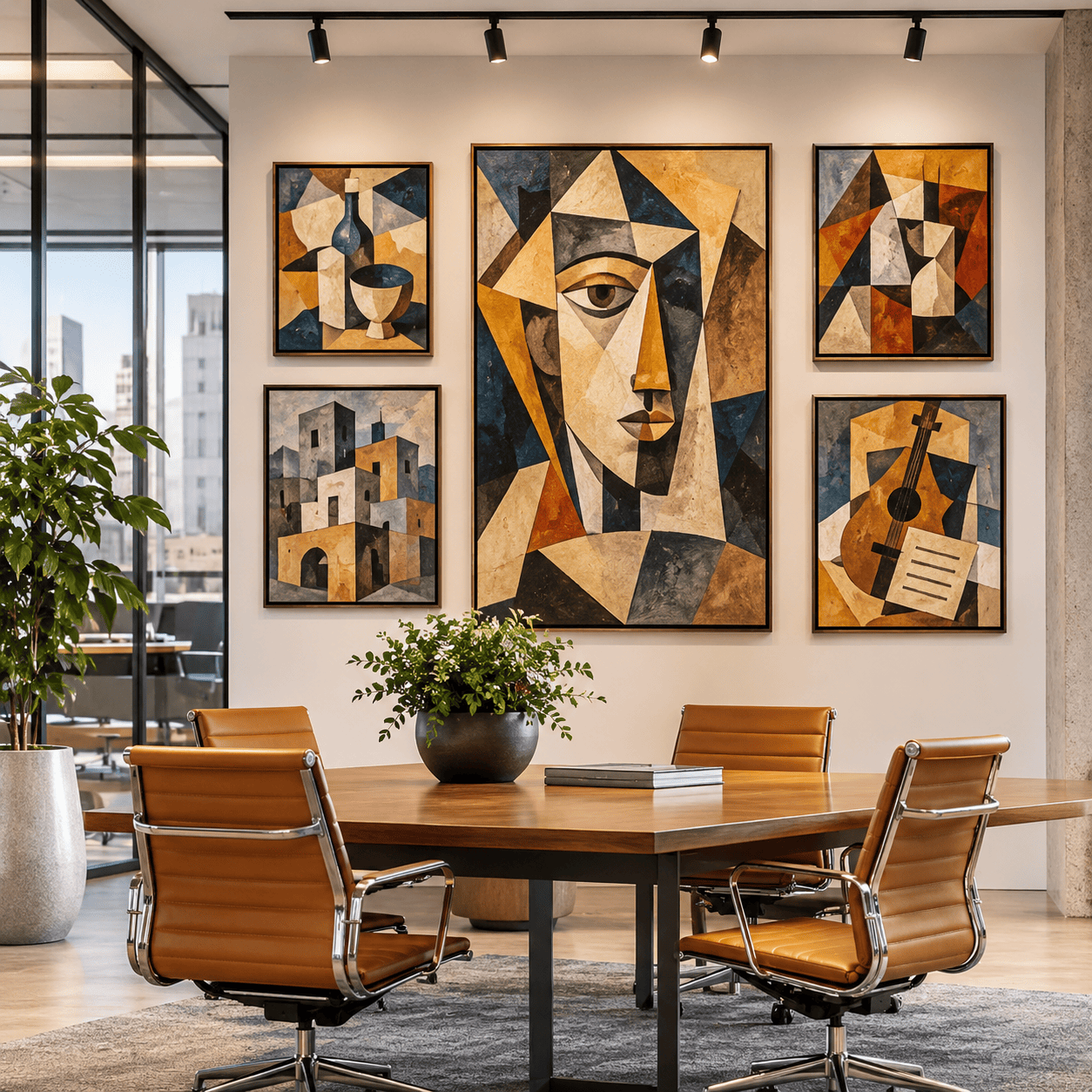
Arranging an office artwork installation is quite different from displaying art in a traditional gallery or residential space. As a rule, business art collections serve as a natural extension of brand identity and help communicate a company's values and message.
Few art movements offer as many possibilities for contemporary office interiors as Cubism. Its fractured planes, geometric forms, and interlocking angles can complement the grids of glass partitions, desks, and ceiling tiles found in modern workplaces. Still, the same visual energy that makes a Picasso or Braque so compelling can overwhelm a room if the artwork is displayed without a plan.
Find a Unifying Thread for the Office Artwork Installation
The first step in arranging a Cubist collection is choosing a unifying idea for each wall or designated area. The period is a natural starting point. For instance, the muted ochres and grays often associated with Analytic Cubism can create a quiet, contemplative impression. Flatter shapes, brighter colors, and collage elements characteristic of Synthetic Cubism can introduce a livelier visual effect.
These differences can inform decisions about art placement in offices. Analytic Cubist works may be particularly suitable for meeting rooms, while Synthetic Cubist pieces can bring energy to breakout areas, lobbies, and shared spaces. Mediums should also be considered: prints and drawings can form cohesive groups, while oil paintings may require additional attention to lighting and environmental conditions.
Let the Walls Do the Work
Cubist paintings already contain considerable visual movement, so the surrounding environment should provide some balance. A structured grid can be an effective arrangement for related works, although a carefully planned salon-style display can also work in larger spaces.
Consider selecting one anchor artwork for a prominent wall, such as the main reception area, and arranging smaller groups around it. Consistent framing, complementary colors, and sufficient negative space can help connect individual pieces without making the installation feel crowded.
Consider Height, Spacing, and Light
Artwork should be positioned for comfortable viewing in each office environment. A centerline of approximately 57–60 inches from the floor is a common starting point for standing viewers, but the height should be adjusted for seated viewing areas, furniture placement, and the dimensions of the artwork.
Spacing also influences the overall composition. Closely related prints may benefit from tighter grouping, while larger paintings often need more surrounding space to stand out. Lighting should be even and controlled, with direct sunlight and excessive exposure avoided to help protect the artworks.
Mind Safe Installation Rules
Beyond aesthetic considerations, office artwork installation must meet practical safety requirements. Unlike galleries, offices are busy environments where people move continuously and interact with their surroundings. A safe installation requires assessing wall construction, artwork weight, appropriate mounting hardware, and the location of concealed cables and pipes. For heavy or valuable pieces, professional art handlers can help determine suitable mounting methods and ensure secure placement.