


Acrylic paint films are thermoplastic, meaning they can soften when exposed to elevated temperatures rather than behaving like permanently hardened materials. This is why an acrylic painting can remain responsive to temperature changes even years after its creation. Temperature affects the paint film’s flexibility, tackiness, and resistance to pressure. So, how acrylic paintings react to heat depends on the paint formulation, the temperature reached, and the duration of exposure.
What Is Acrylic Paint?
To understand how acrylic paintings react to heat, you need to know the chemical properties of this paint type. Acrylic paint consists of pigments dispersed in an acrylic polymer binder, with water and other components used in the wet formulation. As water evaporates, the polymer particles come together to form a continuous film. Once dry, the film remains a polymeric material whose physical properties can change with temperature.
One important parameter is the glass transition temperature (Tg), the range at which a polymer changes from a harder, glass-like state to a softer, more rubbery one. Tg varies considerably among acrylic formulations, so there is no single temperature that applies to every acrylic painting. Some acrylic conservation materials, for example, have Tg values ranging from about 110°F to 190°F.
How Acrylic Paintings React to Heat: Dynamics at a Glance
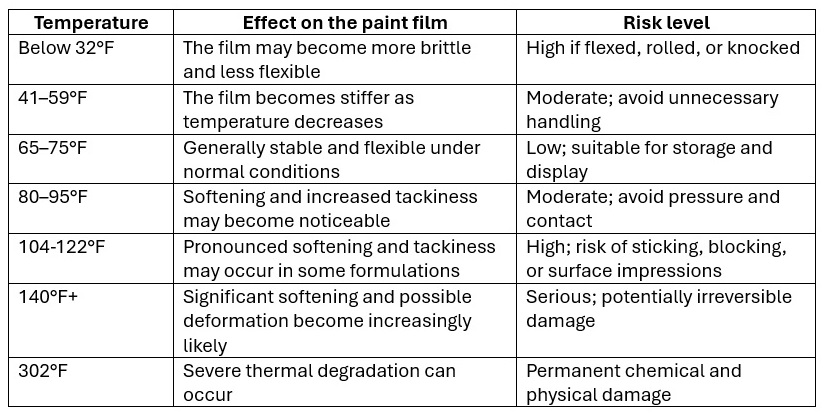
The table provides general guidance rather than universal thresholds. Acrylic formulations differ, and prolonged exposure to a lower temperature can also cause damage.
Precautions Against Heat Damage
- Keep display and storage room temperature around 64–75°F, with RH of 45–55%.
- Never hang acrylic paintings close to radiators, heating vents, or in direct sunlight.
- Don’t store acrylic paintings face-to-face or stacked, particularly in warm conditions.
- Use an appropriate isolation coat or removable varnish when recommended for the specific artwork and conservation requirements.
- Clean acrylic paintings only when they are cool and fully at room temperature.
FAQs
Can acrylic paint melt?
Acrylic paint generally softens before it undergoes severe thermal degradation. The exact temperature at which softening, deformation, or chemical breakdown occurs depends on the specific formulation. Therefore, there is no single “melting point” that applies to all acrylic paintings.
Is heat or cold worse for acrylics?
Both can cause problems, but in different ways. Heat can increase softness and tackiness, creating a risk of sticking, pressure marks, and surface deformation. Cold can make the film more brittle and vulnerable to cracking when the painting is flexed or handled.
Is heat damage reversible?
Sometimes. If an acrylic surface becomes temporarily tacky, it may return to a less tacky state after cooling. However, if dust becomes embedded or another material leaves an imprint while the surface is soft, the resulting damage may be permanent and require professional conservation.