


Fine art shipping requires specialized handling, climate protection, custom packing, and trained logistics professionals. Standard freight transportation is designed for commercial cargo, not for fragile and high-value artworks. That is why standard freight companies should never ship fine art.
Collectors, galleries, museums, and artists often underestimate the difference between conventional freight shipping and professional fine art logistics. However, using the wrong transportation provider can expose artwork to vibration, impact damage, humidity fluctuations, and improper handling.
Why Standard Freight Companies Should Never Ship Fine Art
Traditional freight companies focus on efficiency, volume, and speed. Their systems are optimized for transporting palletized goods, retail inventory, industrial equipment, and standardized cargo. Most freight terminals rely on automated sorting systems, forklifts, loading docks, and consolidated shipments.
Artwork does not fit into these standardized logistics processes. Paintings, sculptures, antiques, and mixed-media installations require individualized care throughout transportation. Even minor mishandling may result in irreversible damage.
This is the main reason why standard freight companies should never ship fine art. Their infrastructure and handling procedures are not designed for delicate cultural property.
How Fine Art Shipping Differs from Standard Freight
Professional fine art shipping companies approach every shipment individually. Before transportation begins, art handlers assess the artwork’s dimensions, materials, fragility, and environmental sensitivities. Based on that assessment, they develop a customized packing and transportation strategy.
Fine art logistics providers typically offer:
- Museum-grade custom crating
- Climate-controlled transportation
- White-glove art handling
- Professional installation and deinstallation
- Condition reporting before and after transit
- Specialized fine art insurance coverage
- Secure storage solutions
- Customs coordination for international shipments
Unlike standard freight companies, fine art shippers prioritize preservation and risk reduction over shipping speed.
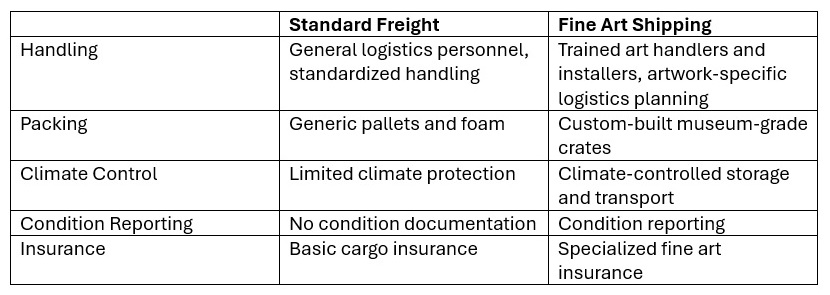
Standard Freight vs. Fine Art Shipping
The difference between these services becomes even clearer when comparing their operational standards.
Q&A
Can a standard freight company ship art safely if it’s professionally packed?
Even with high-quality packing, there is no guarantee of safe handling within a standard freight network. Most conventional shipping systems rely on automated sorting, repeated loading procedures, and generalized cargo handling methods that increase the risk of accidental damage.
Is fine art shipping more expensive than standard freight shipping?
Yes. Fine art shipping typically costs more because it includes specialized handling, custom crating, climate-controlled transport, condition reporting, and higher insurance coverage. Standard freight pricing is usually based only on cargo dimensions and weight.
How can I verify a fine art shipping company’s expertise?
Review the company’s portfolio, client testimonials, and experience working with galleries, museums, collectors, or auction houses. It is also important to check insurance coverage and online reviews.