

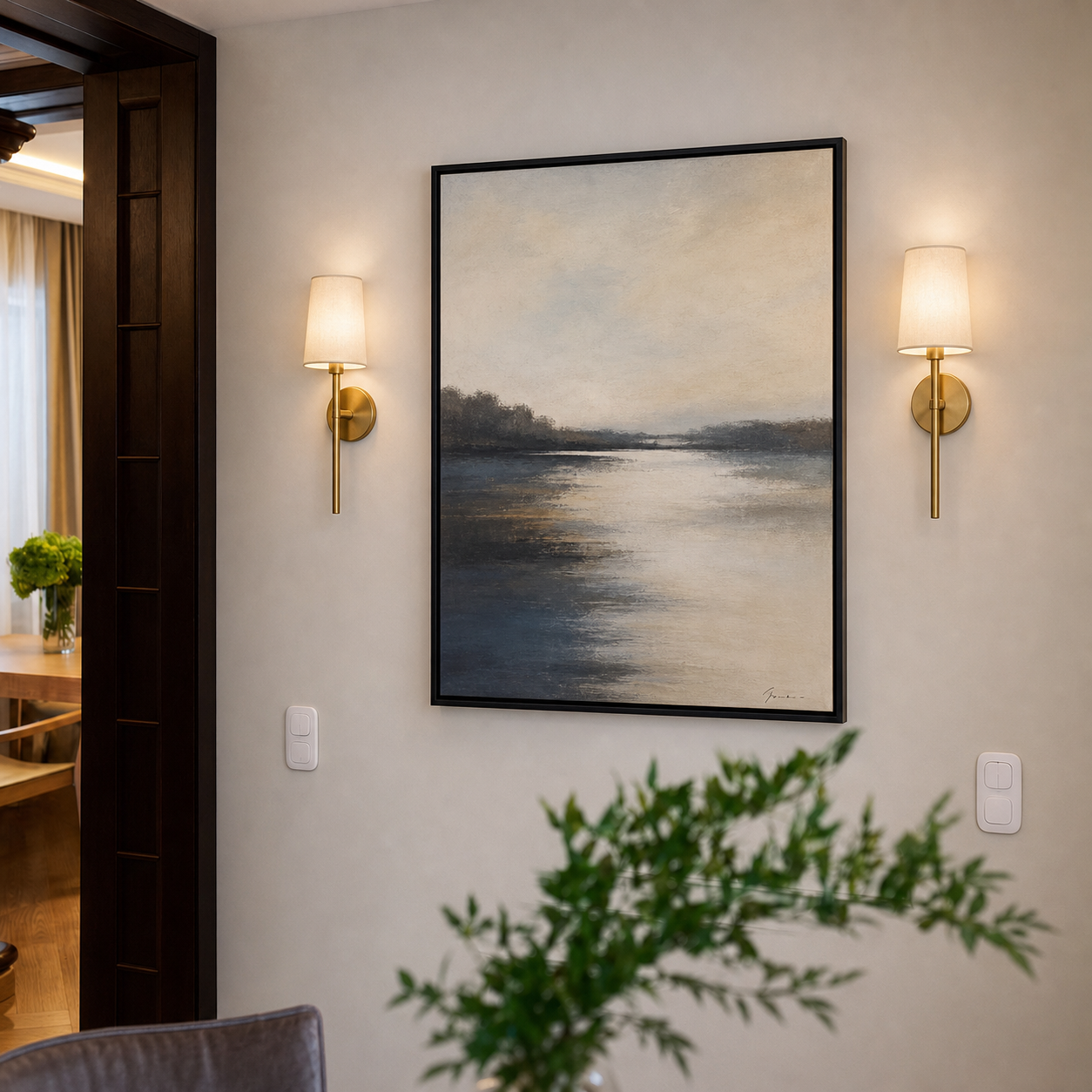
A Manhattan collector spent six months sourcing a mid-century abstract that finally anchored their living room. Three years later, they noticed the canvas had developed a yellow cast along the top edge where their recessed ceiling lights hit directly. The piece hadn't changed. The lighting had quietly damaged it.
Most artwork deterioration happens slowly enough that owners miss it until restoration becomes necessary. Poor lighting choices accelerate fading, discoloration, and material breakdown in ways that feel invisible at first. Installing wall sconces positioned to illuminate art from the sides rather than overhead or below creates even distribution without concentrated heat or UV exposure on any single area of the canvas or frame. These fixtures allow collectors to control intensity, direction, and color temperature in ways that ceiling-mounted or track systems can't match. The difference isn't just aesthetic. It's preservation.
Why Standard Overhead Lighting Damages Artwork
Recessed ceiling lights and track fixtures create concentrated heat zones. According to a 2025 study from the Getty Conservation Institute, artworks exposed to overhead lighting at standard residential distances experience surface temperatures 12 to 18 degrees higher than ambient room temperature. Oil paint, varnish, and adhesives respond to these temperature swings by expanding and contracting, which stresses the substrate and accelerates cracking.
The issue compounds with time. A painting hung below a halogen track light for five years will show measurably more surface damage than an identical piece lit from the side at the same lumen output. The concentrated beam creates a hot spot rather than distributing warmth across the full surface. Canvases are particularly vulnerable because the fabric backing traps heat against the paint layer.
Overhead fixtures also create glare on framed works. Light striking glass or varnished surfaces at steep angles reflects directly into the viewer's eye, which obscures detail and forces people to view the piece from awkward positions. Side-mounted fixtures eliminate this by approaching the artwork at gentler angles, typically between 25 and 35 degrees from vertical.
The Temperature Problem Nobody Talks About
Wall-mounted lighting generates less localized heat than ceiling fixtures because the light source sits farther from the artwork and disperses energy over a wider area. LED fixtures designed for gallery use maintain surface temperatures within 3 to 5 degrees of room ambient, according to testing by the Smithsonian's Museum Conservation Institute. Compare that to the 15-degree spikes common with overhead halogens, and the preservation advantage becomes clear.
A private collector in Los Angeles installed LED sconces along their hallway gallery after noticing frame separation on several works hung beneath recessed lighting. Within six months of switching to side-mounted fixtures with adjustable output, they stopped seeing new damage. The frames stabilized because the wood and canvas no longer cycled through daily temperature stress. They didn't change the art or the room conditions. They changed where the heat came from.
Thermal cameras reveal the difference instantly. Overhead lights create bright spots on artwork surfaces that register several degrees warmer than surrounding areas. Side lighting from properly positioned fixtures shows even temperature distribution across the entire piece. Museums have known this for decades. Residential collectors are starting to catch up.
UV Output and Spectrum Considerations
Not all light damages art equally. Ultraviolet radiation breaks down organic materials like canvas, paper, pigments, and varnish at the molecular level. A 2026 report from the International Institute for Conservation notes that UV exposure between 380 and 400 nanometers causes irreversible fading in most natural dyes and some synthetic pigments within 500 hours of cumulative exposure.
LED fixtures rated below 10 microwatts per lumen of UV output provide the safest option for lighting valuable work. Many residential sconces now meet this standard, though buyers need to verify specifications rather than assume. Incandescent and halogen sources emit significantly more UV than LEDs, even when filtered. Fluorescent tubes vary widely depending on phosphor coating quality.
Color temperature matters as much as UV content. Museum conservators recommend 2700K to 3000K for most artwork because this range mimics natural daylight without the harshness of cooler LEDs. Higher color temperatures above 4000K can make some pigments appear washed out and create visual discomfort during extended viewing. The Illuminating Engineering Society's 2025 guidelines specify 3000K as optimal for residential gallery spaces where art preservation and viewing comfort both matter.
Positioning Wall Fixtures to Prevent Glare
Sconces should sit 60 to 75 inches above the floor for standard eye-level artwork. This height allows the light to strike the canvas at approximately 30 degrees from vertical, which minimizes reflection on glazed surfaces while providing even coverage across the piece. Fixtures placed too high create shadows at the bottom of the frame. Too low, and they cast light upward in ways that distort color perception and create hotspots on ceilings.
Distance from the wall matters as much as height. Fixtures mounted 12 to 18 inches from the artwork's edge produce the most balanced illumination without washing out detail or creating harsh shadows. A sconce positioned too close will overlight the nearest section while leaving far edges dim. Too far, and the beam disperses before reaching the canvas, reducing contrast and making details harder to see.
Adjustable fixtures give collectors flexibility to refine positioning after installation. A Santa Monica gallery owner who specializes in contemporary photography notes that they often tweak fixture angles by 5 to 10 degrees depending on frame depth and glass reflectivity. That level of control prevents glare issues that fixed-position lights can't solve. They’ve found that most problems with gallery wall lighting trace back to fixtures that looked right during installation but couldn't adapt to how the art actually behaves under different lighting conditions.