

Ask most collectors what worries them about putting things in storage, and they will say theft. It is the wrong first worry.
Security at a well-run facility is close to a solved problem: cameras, gated access, monitored alarms, staff on site. The harder question, and the one that damages far more artwork than break-ins do, is what the air inside the unit does across a winter.
Security is the part that gets solved
Take security seriously, then set it aside: good operators have converged on much the same answer.
Look for CCTV recording around the clock rather than cameras that only record when someone is watching, controlled entry by PIN, keycard, or app so there is a log of who came and went, alarms that are monitored rather than merely loud, and staff on site in opening hours. The unit lock is usually your decision: hardened steel or a disc lock, not a cheap combination padlock. Ask directly about overnight patrols, and treat a straight no as a good sign. An operator who tells you exactly what they do and do not provide is easier to plan around than one implying blanket protection.
What none of that addresses is the environment.
The numbers a conservator works to
The Bizot Green Protocol, adopted by institutions including Tate, MoMA, the Guggenheim, the Rijksmuseum, and the V&A, sets the working range for objects containing hygroscopic material such as canvas paintings and textiles.
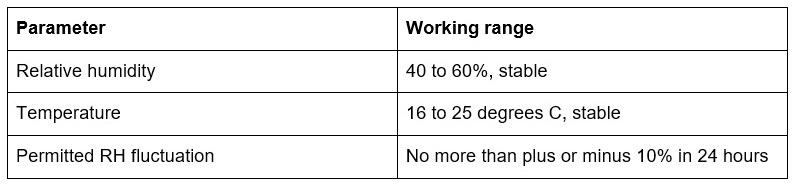
The protocol's own handbook is candid about those figures: it states they have no fundamental scientific meaning and represent values that seemed reasonably acceptable ten years ago. They are a starting point for risk management, not a magic threshold.
The three things that go wrong
Mold has the hardest numbers attached. The handbook cites microscopic mold at relative humidity as low as 60%, with visible growth on susceptible materials after roughly three months at 70% RH, or about one week at 85% RH. An unheated building through a damp fall can sit in that range for weeks. Stable is not automatically safe: a unit steady at 75% RH all winter is worse than one that swings, because periodic drops below 60% reset the mold clock to zero.
Cold is the mechanism collectors most often miss. Most paints are flexible and tough at room temperature and become brittle as they cool, the transition falling somewhere between about 10 and 0 degrees C. A unit that drops to five degrees in January has not simply made your paintings cold. It has made them fragile, and fragile things do not survive being knocked or stacked against.
Dimensional stress does the rest. Wood, paper, leather, and parchment take up and give off moisture, and swell and shrink as they do. Restrain that movement, with a rigid frame or a paint layer bound to a support that moves differently, and stress builds. Sensitive objects tolerate fluctuations of around 10% RH either side, while variations beyond 20% bring a rapidly rising risk of fracture. Above 75% RH, wood deforms more readily and metals corrode faster.
Cool is good for chemistry, though: every 5 degrees C of reduction roughly doubles the expected lifetime of chemically unstable materials. Only cold becomes a mechanical problem.
What self-storage is genuinely good for
General storage handles the material that surrounds a collection rather than the collection itself. Empty frames and stretchers. Crates and travel cases between shipments. Packing materials, plinths, and display hardware. Furniture with no marquetry, veneer, or gesso. The contents of a room during a renovation, which is when most collectors need space urgently.
That is a real need, and it costs far less than art storage. Providers of secure storage units such as Sentry Self Storage, which runs 23 sites across the south of England with round-the-clock CCTV recording and monitored alarms, cover exactly this bracket. Sentry is UK-based, so readers elsewhere should find the local equivalent; the questions are the same.
What does not belong there, unless the facility can demonstrate active climate control with monitoring data: canvas and panel paintings, works on paper, photographs, textiles, gilded and gessoed objects, veneered furniture, musical instruments, and anything with an unknown conservation history. Those go to a purpose-built art storage, where the extra cost buys a documented environment rather than a locked room.
An operator who tells you sensitive items may need extra care is being straight with you. One who implies a standard unit is fine for a painting is not.
If something sensitive has to go in briefly
Frame and back-board the work first. The Bizot handbook lists well-sealed, back-boarded frames with glazing as an effective measure because they flatten out swings in relative humidity. A sealed frame is a small microclimate, and it does more than the room around it.
After that: keep everything off the floor on pallets or shelving, wrap in breathable materials rather than sealing damp air against a surface, keep cardboard away from anything valuable, put a cheap data logger in the unit so you have a record rather than a guess, and check the insurance limits since most policies cap high-value items unless they are declared.
Four questions before anything goes in
- What is the unit's temperature and humidity range across a year? If nobody can tell you, assume it tracks the outside.
- Is the item hygroscopic? Canvas, wood, paper, textile, gesso, leather, parchment.
- Has it lived through uncontrolled conditions before? Acclimatized objects carry less new risk than recently conserved ones.
- Is it going in for six weeks or six years? Duration matters most for mold. For anything of real value, ask a conservator.
The bottom line
Self-storage answers a specific question, and the question is not where to put your collection. It is where to put everything else while you deal with it: frames, crates, furniture, packing, the overflow from a move or a renovation. For that, a well-run secure facility is appropriate and far cheaper than the alternative.
The works themselves are a conversation about air rather than locks. Anyone who has watched a panel crack in a dry January knows the thief was never the main risk.
Source: Groupe Bizot, Handbook #1: Adopting the Bizot Green Guidelines, September 2023, hosted by the National Museum Directors' Council. All temperature, humidity, mold, glass-transition, and proofed-fluctuation figures above are taken from section 2 of that handbook.