

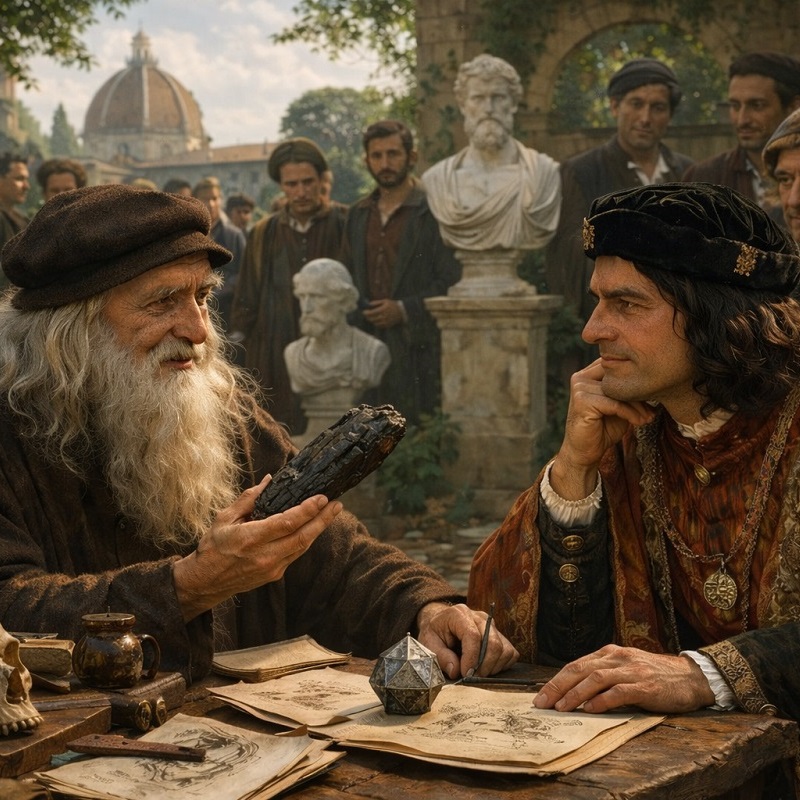
Researchers at the UNESCO Club of Florence have recently announced a revolutionary finding. An expert team consisting of Annalisa Di Maria, Andrea da Montefeltro, and Lucica Bianchi uncovered Leonardo da Vinci’s insightful commentary on conservation-grade wood treatment in his Codex Madrid II.
About Codex Madrid II
Leonardo da Vinci went down in history not only as a genius Renaissance painter but also as a skilled engineer. The Codex was written in 1491–1505, offering a personal account of da Vinci’s inquiry into the physics of construction. While the first part of the Codex deals with mechanics and gears, the second part represents an integrated understanding of the engineering process.
Da Vinci on Wood Preservation
Though most researchers link Codex Madrid II to fortifications and hydraulics, it also contains da Vinci’s observations that if wood is debarked and slightly charred, it becomes much more resilient to decay. Da Vinci presented a detailed table of thermal decomposition stages, including wood drying, pre-pyrolysis, onset of exothermic pyrolysis, and complete carbonization. Each stage was justified with proper regard to the chemical processes occurring in wood, targeting its durability. Da Vinci also offered a classification of wood species in terms of their properties (flexibility, durability, impact resistance, and dimensional stability), with recommendations on their use for different construction purposes.
This finding means that Leonardo da Vinci understood almost five centuries ago that surface-burning of wood protected it from environmental effects by means of removing moisture traps, reducing nutrients for fungi and insects, and creating a moisture-resistant carbon layer formed from burnt surface elements. This way, fire-treated wood exhibits better resistance to heat transfer, which makes it safer for use in construction.

Da Vinci as a Forerunner of Modern Bioarchitecture
The fragment about wood treatment techniques is located in folio 87r of the Codex, dedicated to fortifications and war machine construction. This means that for da Vinci, the longevity of wood was not an aesthetic aspect related to art creation but a practical tool that could be used for sustainable engineering. His witty observations still offer a lot to art conservation and material science.
Leonardo da Vinci’s in-depth study of wood properties and suggestions on wood treatment are consonant with the present-day push for low-carbon construction. His method has much in common with the Japanese Yakisugi technique of wood processing, which emerged nearly two centuries after da Vinci’s discoveries. These findings suggest that Leonardo da Vinci was a pioneer of wood processing techniques, informing global practices and contemporary environmental policy trends.