

Luxury-price momentum
Luxury-price momentum is driving West Palm Beach's priciest homes to fresh records. In January 2026, pending sales in the top five percent of the market jumped 30 percent year over year—six times faster than non-luxury deals. The median closing hit $4.24 million, up 10.7 percent in twelve months and nearly double the national luxury gain. Ten years ago, that tier averaged about $1.48 million, giving a 187 percent decade-long pop.
Why the outlier growth? Cash-rich buyers from Wall Street and Silicon Valley crave waterfront views, quick flights, and—crucially—no state income tax. Meanwhile, new luxury listings fell 4.3 percent, so demand keeps bidding up each closing rather than spreading across more inventory.
What this means for you: rapid appreciation can supercharge an equity-led play, yet sky-high entry prices compress cap rates unless rents rise in lockstep. If your plan banks on equity growth over immediate yield, West Palm's luxury lane is still the hottest track in town. Otherwise, keep reading—we'll stress-test the rental math next.
Rental yields still beat the national pack
Rental yield is the share of annual rent you collect relative to your purchase price, and in West Palm Beach, it still outpaces the country. An ATTOM study pegs the single-family yield at 8.5 percent, topping the 7.5 percent United States average and putting the metro near the top of the income list.
Street-level math backs that up. A typical three-bed lease commands $2,600 – $2,800 a month. Use the midpoint, $2,700, and you earn just over $32,000 in gross rent per year. Divide that by Zillow's early-2026 median home value of $391,000, and the cap-rate calculator lands close to eight percent—exactly where the research says it should.
For investors, that healthy yield means deals can still pencil, even if price appreciation pauses. Just remember: the headline number is before expenses.
Ownership costs: the silent yield killer
Florida's no-income-tax pitch sounds great, but West Palm Beach's carrying costs can erode a cap rate fast.
Insurance is the first bite. Hurricane losses and retreating carriers pushed premiums sky-high. Axios reports that over one-third of Florida homeowners pay at least $3,000 per year for coverage, and insurance now eats roughly twenty percent of the average mortgage payment in South Florida.
Next come HOA dues. New downtown towers often charge $1,500 to $3,000 per month to fund concierge teams, chilled-water AC, and growing wind-mitigation reserves. Single-family owners skip the dues, yet they shoulder steeper wind deductibles plus separate flood policies.
Property tax finishes the trio, and recent numbers collected by www.squarefoothomes.com/real-estate/west-palm-beach/ peg Palm Beach County's effective rate at roughly 1.12 percent. That sounds mild until a seven-figure purchase amplifies it. A $4.24 million condo produces more than $50,000 in annual tax before exemptions.
Put those costs into our earlier median example. Start with $32,000 of gross rent, subtract $4,000 for insurance, $7,200 for HOA dues, and $4,700 for taxes. Your eight-percent gross yield tumbles to just above four percent net, before vacancy, repairs, or management fees.
The lesson: in West Palm Beach, expenses behave like a second mortgage. Budget them carefully, or watch projected returns drift away with the next storm warning.
Neighborhood roulette: picking the right square on the board
West Palm Beach's mood changes every few blocks. Downtown and the Flagler waterfront feel like a smaller Miami, with glass towers, valet lines, and entry prices that start near $700,000. Walk ten minutes inland to North Tamarind, and you reach mid-century bungalows trading for about a third of that amount, alongside slower turnover and softer rents.
Head south to Lake Worth Beach and the atmosphere shifts again. Craftsman cottages share streets with taco trucks, gentrification headlines, and a higher FEMA flood score. The lower sticker price draws investors, yet flood insurance can erase that discount, so keep hazard maps open while you underwrite.
Drive west past I-95, and the palm-lined avenues of Royal Palm Beach and Wellington stretch toward horse country. Land is plentiful, schools score higher, and luxury buyers swap ocean views for stable doors. Cash flow narrows here because estate homes rarely pencil on rent, yet long-term appreciation can rival waterfront condos without storm-surge worries.
One metro, three risk-return profiles. Flip-friendly funds should hug downtown cranes, yield hunters can track three-bedroom rents in North Tamarind, and patient equity seekers may prefer to saddle up in Wellington.
The 60-second deal check
Use this grid as a gut check, not gospel. Swap in your neighborhood's actual HOA, raise insurance for beachfront exposure, or trim taxes if you land a homestead property. If your pro-forma cap rate still beats your hurdle after these haircuts, the deal deserves deeper diligence.
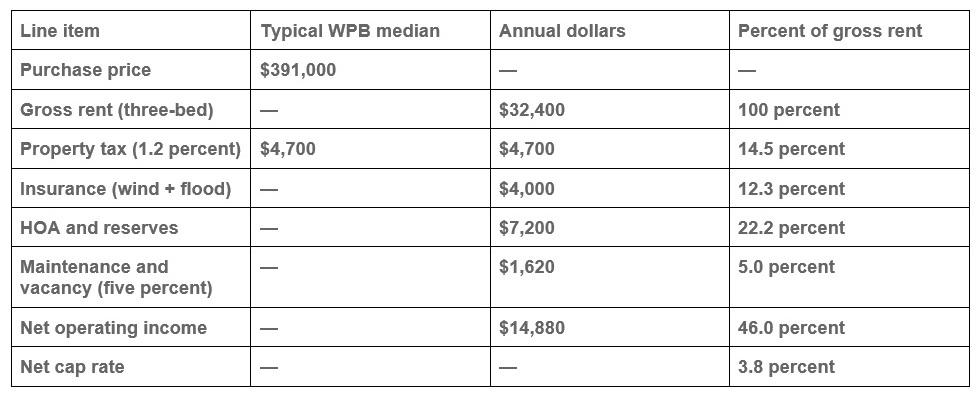
West Palm Beach dazzles in brochures, yet only disciplined math separates postcard investments from profitable ones. Keep this table on your phone, sanity-check each listing, and let the numbers, not the palm trees, drive your next offer.