

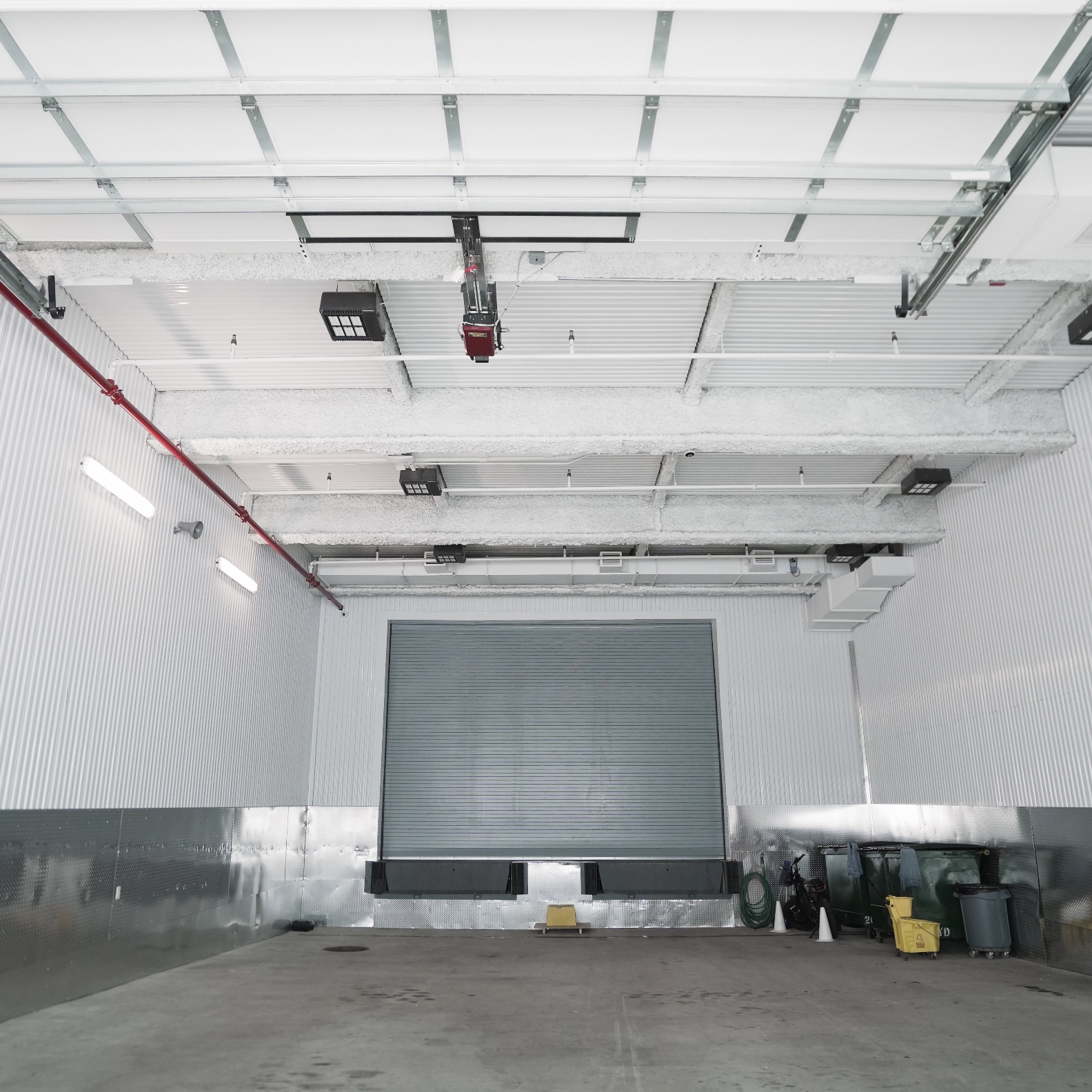
You can rarely tell that you’re looking at a fine art warehouse from the outside. These facilities commonly have no signage and no windows, and they are intentionally located in quiet, low-profile districts. This anonymity is deliberate, with security, stability, and discretion serving as key principles of art warehouse design.
The Envelope
When a visitor steps through the loading dock, the first thing they notice is the air. A professional art warehouse maintains temperature and relative humidity within a very narrow range, commonly around 68–72°F and 45–55% RH. To achieve that level of environmental control, art storage facilities rely on high-quality HVAC systems, dehumidifiers, vapor barriers, and low-emission interior finishes. Loading docks, machine rooms, and workshops are physically separated from storage areas and typically operate with dedicated air-handling equipment to minimize environmental fluctuations.
The Floor Plan
Dedicated fine art warehouse facilities often look more like libraries than traditional storage spaces. Paintings hang from sliding steel screens that can be pulled out on runners, allowing proper ventilation and easy inspection without unstacking artworks. Works on paper and textiles are stored in archival flat files, while sculptures and other three-dimensional objects are placed on industrial steel shelving with padded decking. Crated artworks are typically kept on open racks with forklift access for safe and efficient handling.
Many warehouses also offer private vaults for individual collectors, usually located around the facility's perimeter. Additional spaces may include a conservation and packing workshop that supports day-to-day art management. They may also include a shared viewing room where conservators, collectors, and prospective buyers can examine an artwork without removing it from the building.
Daily Operations of a Fine Art Warehouse
Every process inside an art warehouse is carefully planned, documented, and monitored. Upon arrival, each artwork undergoes a condition report and is photographed before being assigned to its storage location. Many facilities use barcodes or RFID tags to manage large collections accurately and efficiently.
Security is equally rigorous. Access to different warehouse zones is layered through credentialed entry systems, supported by 24/7 CCTV surveillance and intrusion alarms. Some facilities also follow a two-person policy for entering restricted storage areas containing exceptionally valuable artworks, ensuring that no employee is ever alone with a rare masterpiece.
Main Equipment
The main equipment found in a fine art warehouse includes painting screens, archival flat files, industrial steel shelving, pallet jacks, gantries, and forklifts. Many facilities also rely on A-frames, dollies, and hydraulic lift tables for the safe handling of oversized artworks. Environmental monitoring systems with automatic alerts, along with dedicated crating workshops supplied with archival-grade packing materials, complete the infrastructure needed to preserve and protect valuable art collections.