

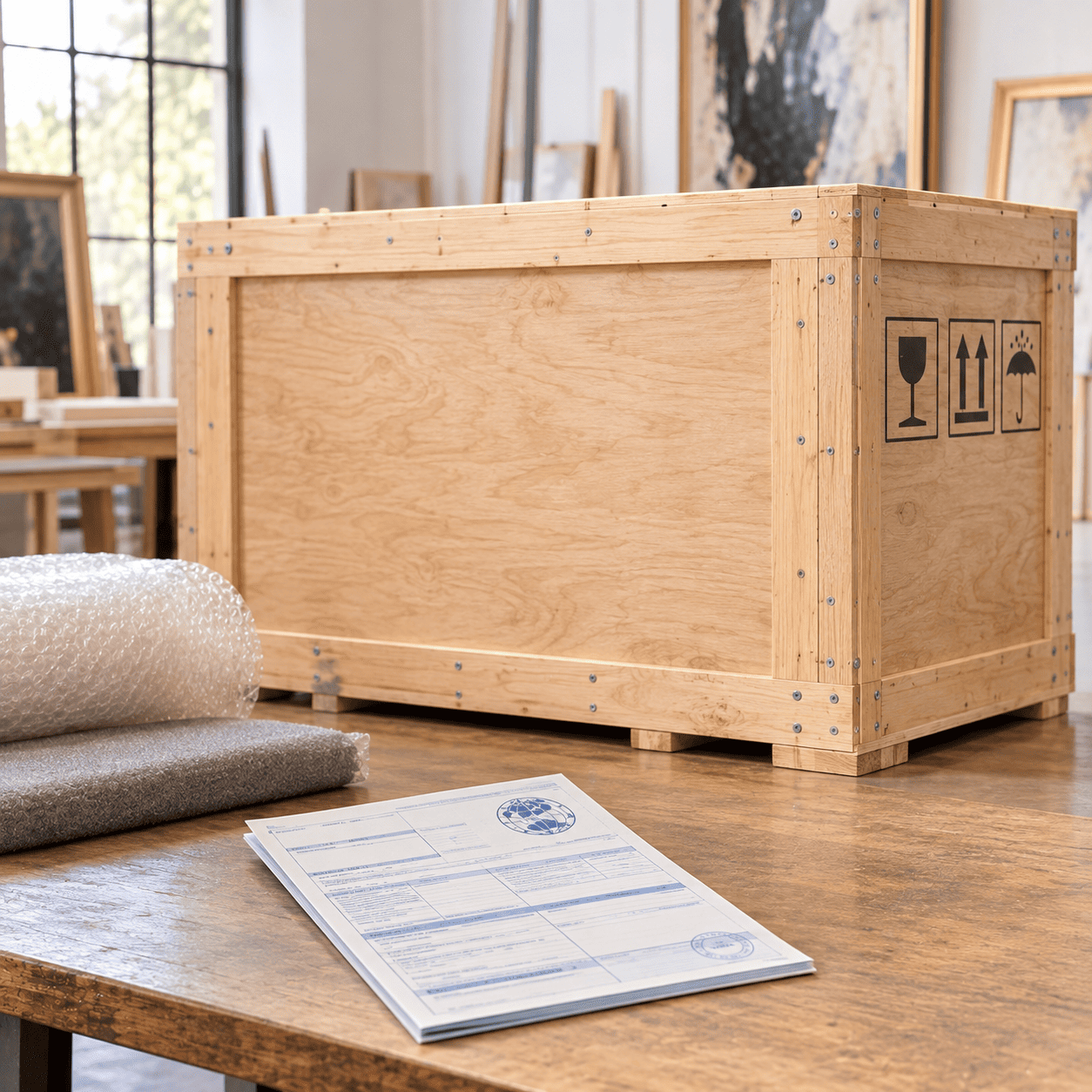
Individual artists and galleries regularly sending artwork to fairs and exhibitions abroad face a common problem: a painting arriving for a brief period of time may still be subject to customs duties and import VAT. The ATA Carnet for artwork was introduced to address this art logistics challenge. It allows eligible art objects to cross international borders as temporary imports without paying customs duties and taxes, provided they are re-exported within the permitted period.
What Is the ATA Carnet for Artwork?
ATA stands for the French and English terms “Admission Temporaire / Temporary Admission.” The carnet is an international customs document, also referred to as a “passport for goods” in art logistics. It simplifies temporary import procedures by serving as a customs declaration for export, import, transit, re-export, and re-import. One carnet lists every item with a detailed description, its value, and country of origin. Customs officials endorse the relevant vouchers and counterfoils every time the collection enters or leaves a territory. No separate deposit is required at the border because an international guarantee chain of national chambers and associations backs every ATA Carnet.
History and Covered Geography
The history of the ATA Carnet started on December 6, 1961, when the Customs Convention on the ATA Carnet for the Temporary Admission of Goods was adopted in Brussels. The convention entered into force on July 30, 1963, and the first carnets were issued that year. In 1990, the system received broader international recognition through the Istanbul Convention on Temporary Admission, which entered into force in 1993. Today, the ATA Carnet system is administered by the World Customs Organization (WCO) and the International Chamber of Commerce (ICC) through its World Chambers Federation. The document is recognized in approximately 80 countries and customs territories, including all EU member states, the UK, the USA, Canada, Australia, and the UAE.
Nuances You Should Know
If you’re planning to obtain the ATA Carnet for artwork, keep the following nuances in mind:
- The document is valid for up to one year. Your artwork must be re-exported from the country of temporary admission within the period authorized by customs and returned to the country of issue.
- The carnet covers temporary visits, such as art fairs and exhibitions, and does not cover artwork sales. If you sell an art object abroad, its temporary import status must be converted into a permanent import, with applicable duties and taxes paid.
- Nothing can be added to the carnet after its issuance, so you must include the entire collection in the itemized list beforehand.
- The issuing chamber charges fees for the carnet and usually requires a security deposit or other financial guarantee, typically calculated as a percentage of the collection’s total value.
- Every customs movement must be properly recorded. Missing stamps or failure to re-export the artwork can result in customs claims and additional charges.
Plan your documentation early and simplify international art transportation with the ATA Carnet. Obtaining this document can make multiple temporary cross-border movements much easier throughout its validity period.