

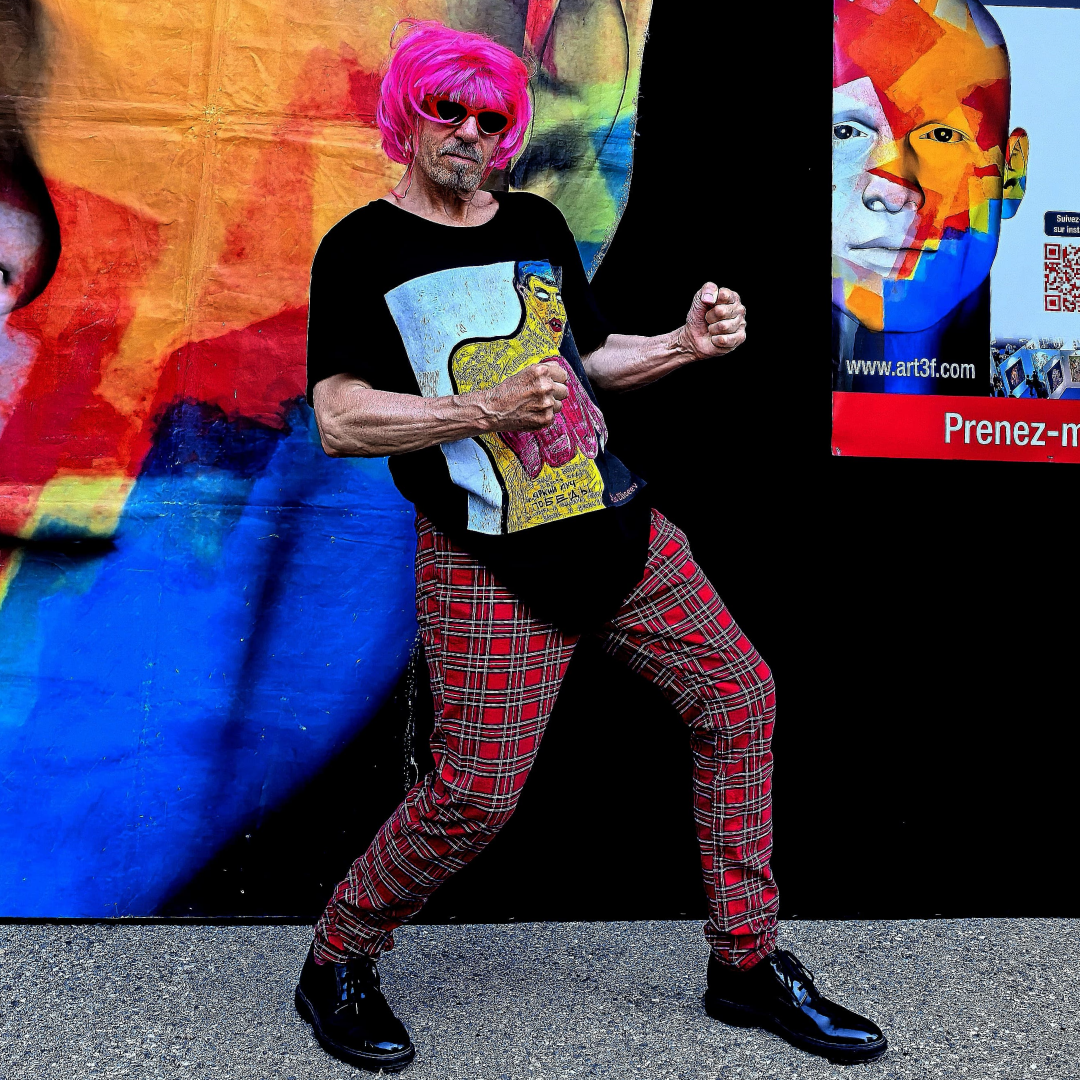
His works are included in the collections of the State Russian Museum and the Centro de Fotografía Isla de Tenerife in Spain, as well as in private collections in New York, Hamburg, Reykjavík, Oslo, Miami, St. Petersburg, and Moscow.
In September 2025, he exhibited at art3f Monaco in Monte Carlo. This January, his work will be on view at art3f Paris, where he’s presenting a solo stand in the heart of the city. Later in the year, he plans to show at major art fairs in London and New York.
In an interview with Fine Art Shippers, he spoke about the diverse origins of his art, his sources of inspiration, and what painting and jazz improvisation have in common.
Your artist journey has taken some interesting turns. You started with photography and later moved into painting. How did that change come about?
Serge Lis Eliseev: I was skeptical of painting for a long time. That changed in 2000, after my father passed away and I found the old Soviet Zenit camera he had left behind. I began walking through St. Petersburg with the camera, photographing the city’s architecture, birds, and people. Later, I started attending fashion shows and photographing them as well. At some point, I realized I was documenting other people’s creativity while I wanted to create something of my own. That was when I began staging my own shoots. I invited models I knew from agencies, styled the sessions myself, and even led runway workshops.
Сan you tell me more about those fashion shoots?
I inherited a collection of vintage women’s clothing and accessories from my mother and grandmothers: dresses, scarves, jewelry, lingerie, satin slips, and old fur hats. I would gather three models, rent a minivan, and drive them to some of the most iconic locations in St. Petersburg.
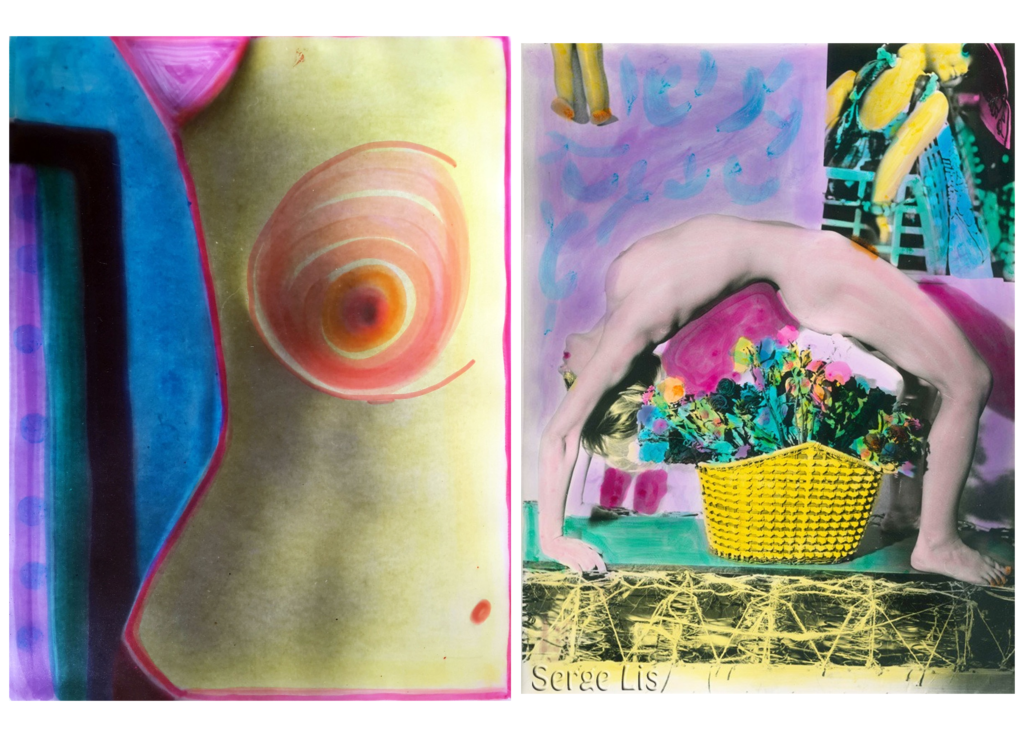
We would park, I’d set up my tripod with a Rolleiflex 3.5 F Model 4, manufactured in 1954 (the same type Helmut Newton used in his work), and shoot on site, often with the models wearing lingerie or styled in those vintage pieces. We had just a few minutes at each spot before moving on. It was quick, spontaneous, and incredibly energizing.
You also did something of a guerrilla-style shoot in a museum. Can you tell me more about that story?
That happened in 2005 at the Ethnographic Museum, not far from the State Russian Museum. There was an exhibition of Spanish fashion designers, titled Fashion Valencia, featuring mannequins dressed in designer pieces and displayed throughout a stunning marble hall, complete with columns and a mezzanine.
I first tried to get official permission to take photos there with models, but they said no. So I came back after hours with a crate of beer as a thank-you for a janitor who let me in. I placed my models among the mannequins. The lighting was perfect, and at times it was hard to tell who was real and who wasn’t.
Your work was all in black and white on film, right? How did you discover color?
I started with that old Zenith, then moved on to a Nikon, and later a Rolleiflex. Everything was analog. I developed and printed the photos myself. At some point, I discovered a technique for hand-coloring black-and-white photographs with aniline dyes. I watched a masterclass, learned the process, and started experimenting— I especially loved working with orange tones. The resulting works looked more like paintings than photographs. In many ways, those prints became my bridge into painting.
When did you start working with oil paint on canvas?
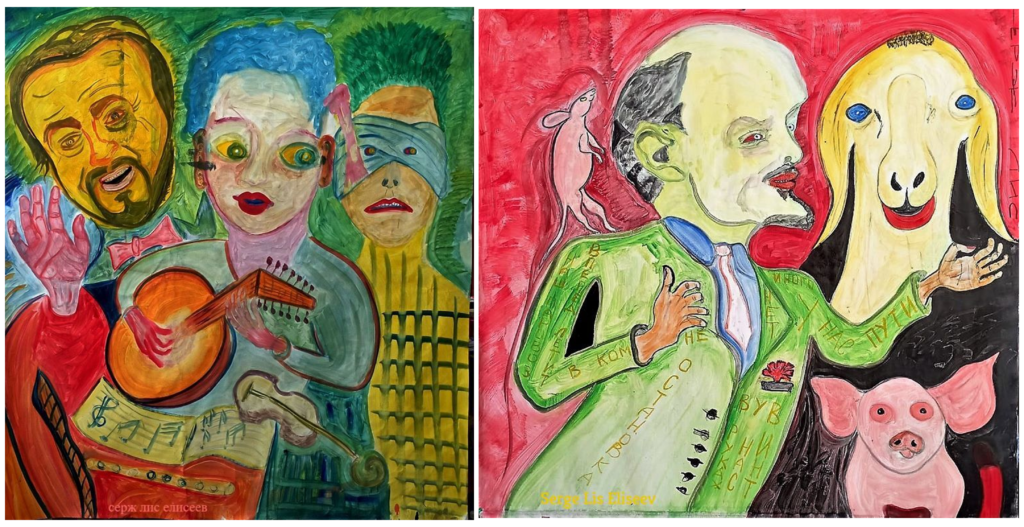
In 2015. I had tried projecting photos onto canvas to use as references, like some artists do, but it didn’t feel right. One day, I simply picked up a brush and started applying oil paint directly onto the canvas. That was the beginning. Since then, I’ve spent most of my time painting.
Have you completely stepped away from photography, or do you still return to it from time to time?
I still come back to it from time to time. I sometimes create hybrid works by combining my hand-colored photographs with acrylic or tempera. I show them at our spring and autumn salons. So yes, photography is still part of my practice, but painting is what I spend most of my time on now.
Your oil paintings are surreal and rich in symbolism. Where do these images come from?
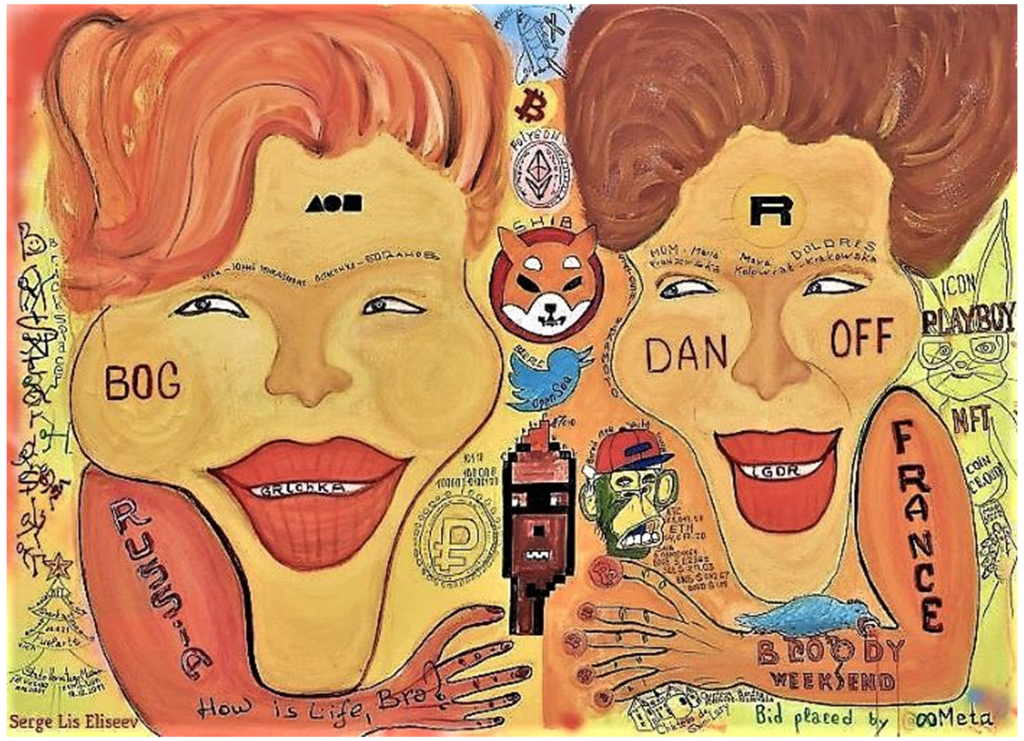
Sometimes they begin with my earlier fashion photos, although they always change along the way. It’s never a direct copy. I work by instinct, following the movement of the brush and letting the image unfold on the canvas. Global events can also leave an impression on me. Trump’s election, the attempt on his life, his inauguration with Melania in that iconic hat — such moments don’t appear literally in the paintings, but they often spark an idea.
I usually start with a portrait, maybe of myself or someone else, and then unexpected elements begin to appear. Animals, strange figures, a pig’s snout, a mouse, a bird. These details come through on their own, like in a jazz improvisation. The painting builds itself layer by layer, and I never quite know where it’s going until it’s there.
Your artistic pseudonym, “Lis,” which means “fox,” where does it come from?
It goes back to my university years. I was in a band called Long Distance, named after a song by the band Yes. Their music had an ethereal quality — high harmonies, complex arrangements. We were all deeply into their sound.
Everyone in the band had a nickname. My last name is Eliseev, so I became “Lis” for short. Later on, I started combining it with “Serge,” inspired by French names like Serge, Henri, and Victor. It was part joke, part alter ego, and it just stuck.
One last question. You seem like someone who lives by a motto. Am I right? Do you have one?
Desire! Patience! Exercise! That's the motto of the old karate masters.
Interview by Inna Logunova
Photo courtesy of Serge Lis Eliseev