

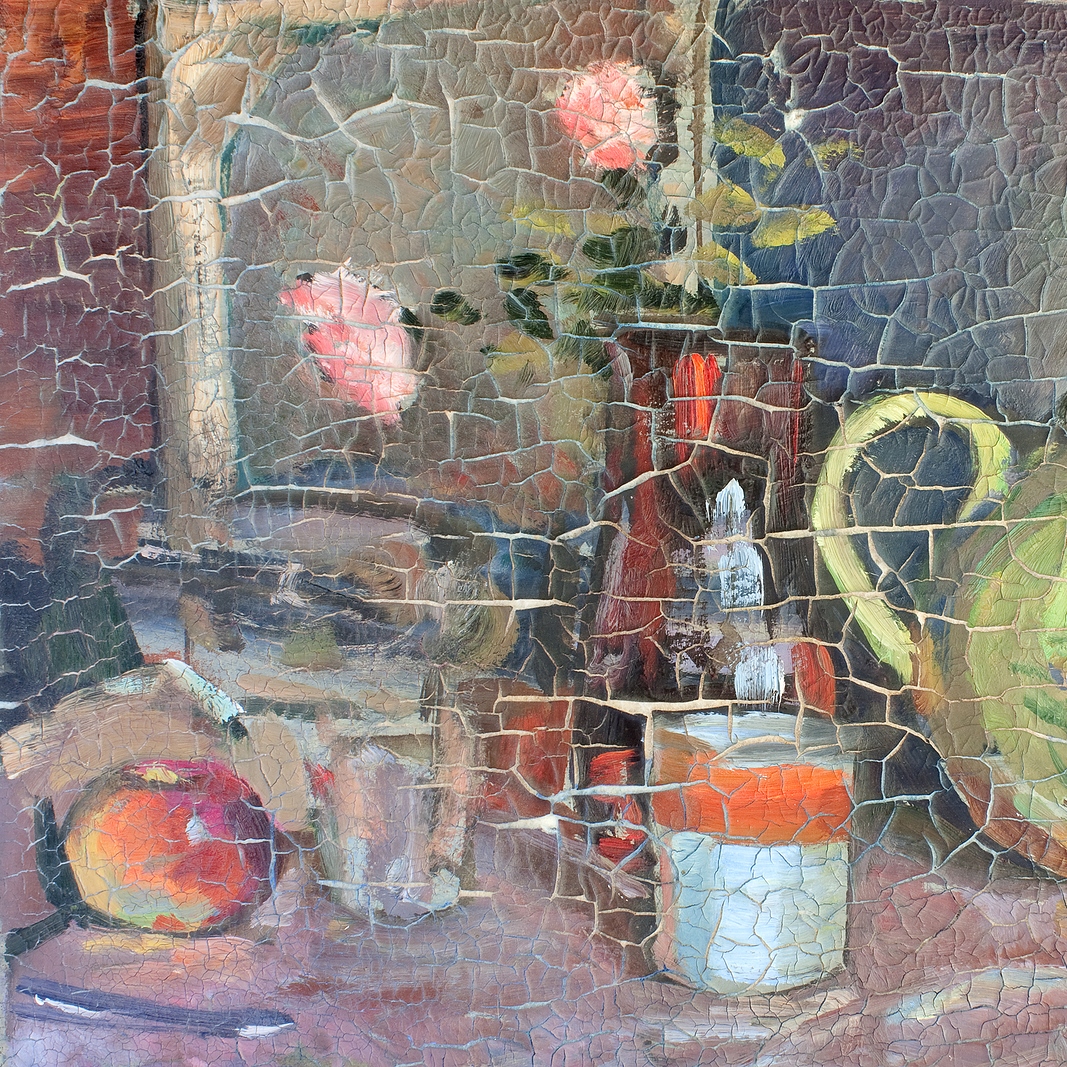
Fine art is environmentally sensitive. Its multiple layers, often composed of natural materials, are chemically unstable and can quickly decay under the influence of temperature and humidity. If art is displayed or stored without climate control, problems won’t surface at once, but the harm can be dramatic. So, what happens when art is stored without climate control? Read on to see what intricate, unnoticeable processes with far-reaching implications happen to artwork stored without proper regard for environmental risks.
What Happens When Art Is Stored Without Climate Control?
The absence of climate control doesn’t cause a single problem; in most cases, it triggers a cascade of destructive processes that act simultaneously on the artwork’s materials. Let’s see how damage occurs in an oil on canvas painting.
Oil and Tempera Paintings on Canvas
Canvas represents a woven textile, which is a breathable material. High moisture causes textiles to expand laterally, while low humidity causes an opposite process – contraction and pulling inward. Oil paint that sits on this moving ground loses adhesion to the canvas. The short-term result is cupping, with small areas of paint starting to lift at their edges. As time goes by, cupping turns into cleavage, with paint physically separating from the canvas. The final stage of damage is flaking, which is characterized by small paint chips and fragments detaching from the canvas and causing holes in the image.
Humidity-related damage is manageable only at the first stages of paint detachment – cupping and cleavage. Restoration is possible until the paint gets fully detached from the canvas fabric. As soon as flaking starts, there is no way to restore the painting.
The effects of temperature swings are similarly destructive for oil on canvas paintings. Cold temperatures add to the effects of humidity changes and make paint increasingly brittle. If the temperature in the display or storage room falls to 50°F (10°C), even indirect physical impact (e.g., the vibration caused by the closing door) can cause cracking of the paint film. Old Masters are extremely vulnerable to these effects because they have very old paint films, which are already stiff. The paint film has many micro-fractures, so the slightest impact can ruin them.
Your Art’s Safety Is in Your Control
Now that you know what happens when art is stored without climate control, you’re in a position to take precautions and protect art from damage. Don’t neglect climate control at all stages of art handling, whether it’s short-term storage or public display at an art fair or exhibition. Keep climate control settings at the non-negotiable threshold of 45-55% relative humidity and 64-70°F (18-21°C) to ensure stable, safe conditions.