


A container office solves a space problem, but it doesn’t simply drop into place. Start by considering permits, site access, power, and comfort.
Introduction: The Rise of Modular Workspaces
Companies may need an office beside a job site, event, or yard. A ground-level container can meet that need.
When a Portable Workspace May Be Practical
A portable office may be a practical option for temporary use. However, permits, utilities, and site preparation can reduce its initial cost advantage.
Why Businesses Convert Shipping Containers into Offices
Insulation, HVAC, power, windows, and a door help turn a portable unit into a usable workspace, but “portable” does not mean permit-free.
Step-by-Step Instructions: Setting Up Your Container Office
Decision order matters. Cutting openings early creates rework and may affect the structure.
Phase 1: Planning, Permits, and Layout Selection
Define occupants, desks, equipment loads, and exits. Ask officials about zoning, setbacks, accessibility, and inspections.
Phase 2: Site Preparation, Foundation, and Delivery
Provide firm, level corner supports and drainage. Midstate advises 80 feet of straight clearance for a 10- or 20-foot tilt-bed delivery and 120 feet for a 40-foot unit, plus 14–16 feet overhead.
Phase 3: Insulation, HVAC, Framing, and Electrical Wiring
HVAC must suit size, insulation, occupancy, and climate. Midstate lists R-13 insulation and model-specific power. An electrician should verify the connection.
Phase 4: Doors, Windows, Lighting, and Interior Finishing
Windows add daylight; bars add a deterrent. Door position shapes circulation and egress. Finishes must tolerate traffic.
Keep the project in this order:
- Confirm use, layout, and approvals.
- Choose the container size and actual base unit.
- Approve all structural openings and reinforcements.
- Prepare the site, utilities, and route.
- Complete insulation, wiring, HVAC, and interior finishes.
- Complete inspections before occupation.
This keeps cosmetic choices from driving technical work and gives every contractor the same plan.
Comprehensive Cost Analysis: Traditional Build vs. Container Office
No calculator fits every site. Compare complete installed budgets for spaces serving the same function.
Base Unit and Customization Cost Breakdown
Published prices are snapshots. A responsible quote should identify:
- Base container and selected condition.
- Design, engineering, permits, and inspections.
- Delivery, equipment, and site preparation.
- Doors, windows, insulation, and wall finish.
- Electrical service, lighting, data, and HVAC.
- Flooring, furniture, accessibility, and security items.
- Ongoing power, maintenance, and future relocation.
Only then can the office be compared fairly with a lease, trailer, or site-built room. Omitting permits or utilities distorts the result.
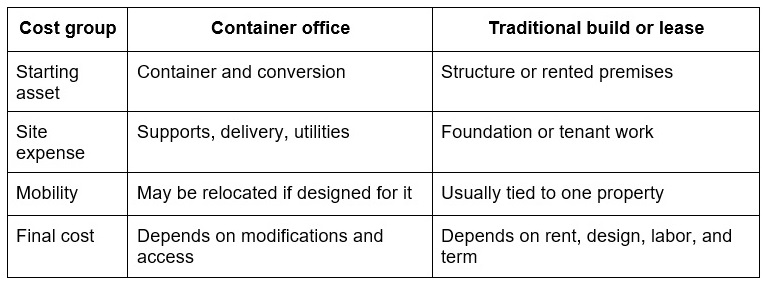
These are decision categories, not guaranteed savings. Both options must meet the same operating and code requirements.
Evaluating Long-Term Cost and Practical Value
Ownership may suit several projects; rental may fit a short assignment. Neither guarantees ROI, and relocation creates new costs.
Why Work with Midstate Containers for Custom Offices
Midstate opened in California in 2000 and added its modification shop in 2014.
In-House Modification Experience and Delivery Planning
The shipping container offices collection includes 10-, 20-, and 40-foot units. Delivery may use a tilt-bed, flatbed, or crane; exact placement is not guaranteed.
Insulation, HVAC, Electrical, and Security Options
Options include steel doors, barred windows, lighting, outlets, HVAC, and insulation. Power varies: one 20-foot unit specifies 120 V, while a 40-foot model lists 230 V HVAC.
Conclusion & Strategic Advantage
A container office should be a documented project, not an improvised shortcut.
Making a Well-Documented Workspace Decision
Compare full costs, approvals, delivery constraints, and service life to judge the value of portability.
Request Your Custom Office Quote
Ask Midstate to confirm the unit, modifications, lead time, delivery, warranty, and exclusions. HVAC and other appliances may have separate manufacturer coverage.