

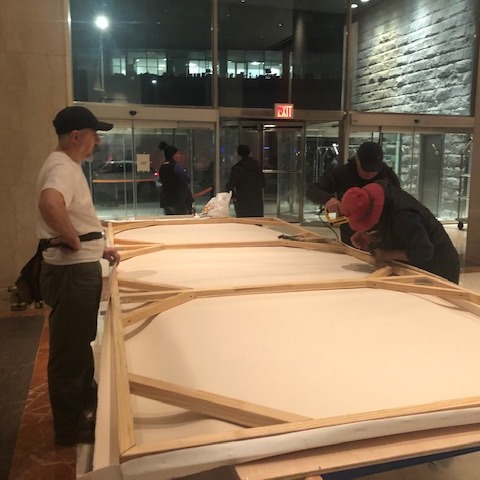
A large canvas, marble sculpture, or vintage framed mirror can easily exceed 100 pounds in weight. Even a team of two art handlers may find it challenging to move such an object, creating risks for both the staff and the artwork. This is where professional hardware for heavy artwork comes into play, and knowing which equipment to choose can make a major difference in handling safety.
Types of Hardware for Heavy Artwork
Professional art handlers use three main types of hardware for heavy artwork: equipment attached to the artwork, hardware attached to the wall, and equipment used to lift or move the artwork.
Attachment Hardware
D-rings and strap hangers are screwed into the back of a frame or stretcher to provide a secure hanging point. Heavy-duty D-rings have individual load ratings, but using two properly installed hanging points helps distribute the load across the frame.
French cleats are commonly used for particularly heavy artwork. They consist of two interlocking strips, each cut at a 45-degree bevel. One strip is fixed to the wall and the other to the back of the artwork. When the artwork is lowered into position, the two bevels lock together. Unlike D-rings, French cleats distribute the load across their full width rather than concentrating it at two points. Aluminum cleats are especially strong and can support substantial loads when properly installed.
Other options include Z-clips, security hangers, T-screws, and hanging wire, depending on the artwork and installation requirements.
Wall Fixings
The quality of the wall fixing matters as much as the hanger itself. When installing heavy artwork on masonry or concrete walls, use appropriately sized sleeve or wedge anchors. For stud walls, fixing directly into the studs is generally the most secure option. Hollow-wall toggle bolts may work for moderately heavy artwork but are not appropriate for very heavy objects unless specifically rated and installed for the application.
Gallery rail systems offer another convenient solution, allowing artwork to be repositioned without repeatedly drilling into the wall.
Lifting and Moving Equipment
To move artwork safely through a space, professionals use A-frames, panel carts, platform dollies, skates, and pallet jacks, with each suited to different types and sizes of artwork. Gantries, hoists, and chain blocks can assist with lifting heavy pieces, while spreader bars and padded slings help distribute the load and reduce pressure on vulnerable areas.
Vacuum suction lifters can be useful for moving glass and certain smooth, non-porous panels, provided the surface and equipment are compatible.
Safety Comes First
Heavy artwork lifting should always follow a safety-first approach. Selecting suitable hardware starts with accurately weighing and measuring the artwork and understanding its construction and center of gravity.
Never rely solely on a manufacturer's maximum load rating. Installation method, hardware condition, wall construction, and load distribution can all affect actual capacity. Appropriate safety factors should be determined based on the specific application, and complex or exceptionally heavy installations should be assessed by qualified professionals.
The right hardware for heavy artwork is not simply about choosing the strongest component. It is about creating a complete, properly rated system that protects both the artwork and the people handling it.