

Today, street art is a mature and globally recognized movement. Yet, its origins in the late 1960s are often overlooked. What began as simple graffiti in urban spaces has grown into a diverse artistic language, celebrated not only on city walls but also in leading galleries worldwide. Tracing the evolution of street art reveals how it gained cultural significance and institutional recognition.
Origins: First Writings on the Walls
Street art may be traced back to ancient times, when people used coal and stones to paint cave walls. Yet, the history of modern street art genuinely belongs to the late 1960s, the period when the first graffiti started emerging in the alleyways of Philadelphia and the subway tunnels of New York. Artists like Cornbread and Cool Earl scrawled their names on the walls, simply to be seen. Around a decade later, these primitive tags were replaced by bright bubble-lettered compositions. TAKI 183, PHASE 2, and LEE became widely known as the first urban jungle painters, creating the recognizable visual language of street art.
The 1980s: From Underground to Gallery
In the 1980s, street art began its transition from anonymous expression to gallery recognition. Artists like Jean-Michel Basquiat, who started with the SAMO© tag, and Keith Haring, known for his subway drawings, brought street aesthetics into the fine art world. Their works attracted collectors and were exhibited in prestigious spaces, signaling a major shift in perception. During this period, stencil art also gained prominence, later popularized globally by Banksy.
Global Expansion and New Voices
The turbulent end of the century coincided with the massive spread of street art as a form of political and aesthetic self-expression. Muralism became popular, with large-scale, community-commissioned wall paintings emerging across locations. Banksy became the leading voice that combined political urgency with stencil art, giving street art new thought-provoking power.
Movable Artwork: A New Chapter in the Evolution of Street Art
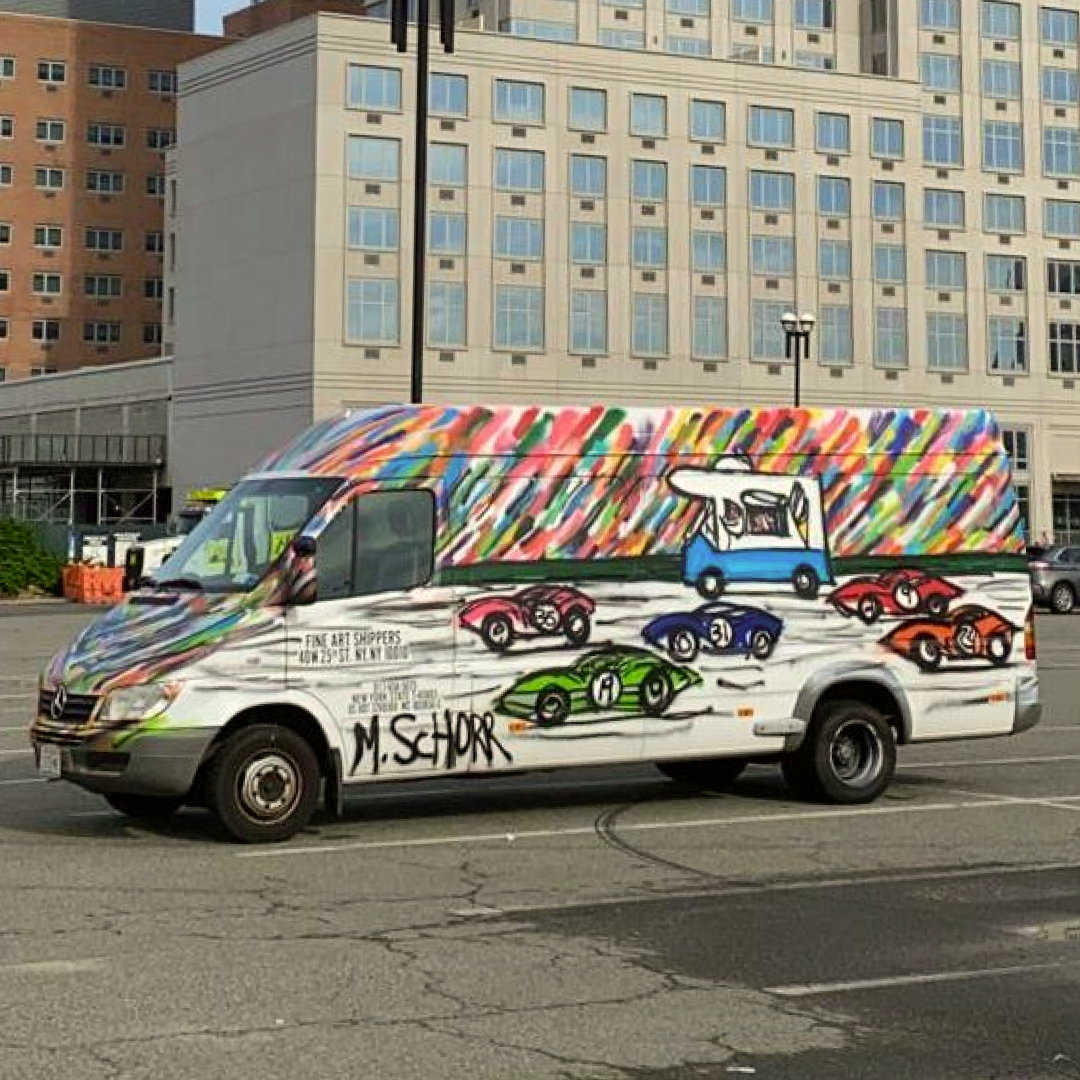
As humanity is firmly moving to the end of the 2020s, the evolution of street art is taking new forms. A novel solution is movable artwork, with recognizable street art images painted on cars and trucks. A notable example is “Da Race on Wheels” by Mitchell Schorr, created in collaboration with Fine Art Shippers.
Since 2021, the art van has traveled across the United States, bringing street art directly into everyday life. Now available for acquisition, it represents a rare opportunity for collectors to own a dynamic piece that embodies the essence of street art.