

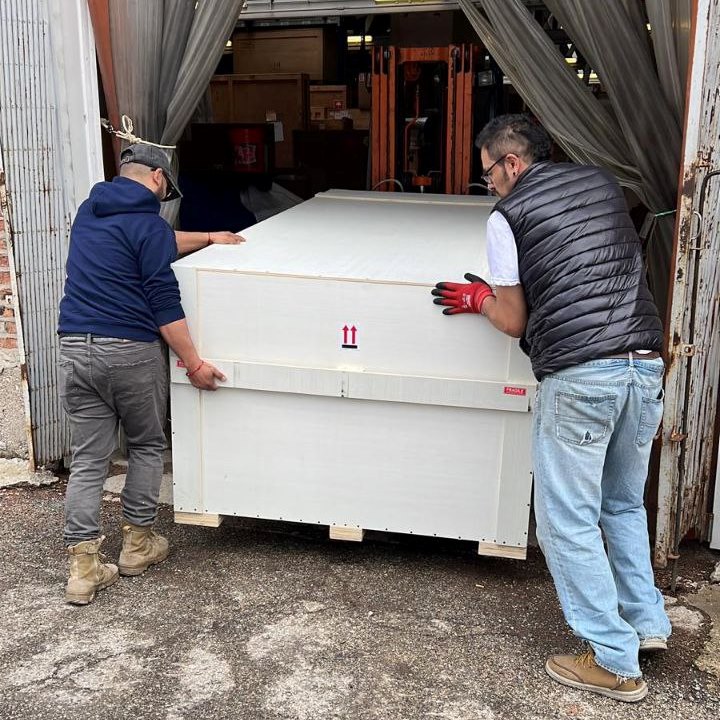
Shipping a large-scale contemporary installation or sculpture is a task with added complexity. Whether domestic or international shipping is concerned, the project requires a blend of engineering expertise and logistics orchestration. Unlike paintings or compact art objects, monumental installations defy traditional logistics tools and need non-standard artwork packing and crating solutions. Let’s see how professionals handle these tasks to guarantee that art reaches its destination safe and sound.
Preparation for Artwork Packing and Crating
If the art object can be disassembled, art handlers do so. It is much easier to ship extra-large sculptures, installations, and mixed-media art in parts, with each of them being thoroughly packed and crated for safe delivery. To perform this task, art handlers make a complete technical assessment of the artwork’s physical behavior. After disassembling, each element undergoes an evaluation for weight and center of gravity, load-bearing point identification, and sensitivity to vibration and torsion. This data informs further artwork packing and crating solutions, including the crate’s design in line with each part’s individual dimensions.
Crate Type Selection
Depending on the art object’s size and structure, art handlers choose from three main crate types:
- Structural crates. This crate has steel or aluminum frames and is covered with plywood skins. The art object is suspended or bolted to internal mounts in such a crate, traveling in a suspended position to avoid weight allocation to any of its surfaces.
- Open/hybrid crates. This crate type suits extremely large or irregular sculptures and is compatible with crane loading. Its core feature is rigidity.
- Multi-crate modular systems. Disassembled sculptures travel in a modular system of independent crates, sequenced for unpacking and reassembly.
Notably, the choice of the most suitable option is not a matter of cost. These crate types come with different mechanical properties and handling constraints, thus suiting different shipping routes and methods.
The Crating Process
Once the crate type is chosen, art shippers proceed with internal sculpture mounting and immobilization. Professional-standard mounting involves the use of custom-fabricated mounts with non-abrasive, inert surfaces and load paths tailored to the sculpture’s most fragile elements. The top priority in crating is immobilization, which ensures that the art object is immune to vibration during movement. In this regard, sculpture crates differ from crates built for paintings, which prioritize cushioning and shock absorption.
Professionals also include environmental and technical considerations in the crate’s design for sculpture packaging. That’s why top-tier crates account for thermal expansion of metals and factor in the condensation risk of air-to-ground freight transitions. These principles form the core of crating services, guaranteeing infallible safety for your art.